A friend paid for the portrait. The children were the banker’s. But the long-legged stranger at their side belonged to someone else entirely, and he has been hiding in plain sight at the Metropolitan Museum for more than a century.
His name was Dunrobin, a Scottish Deerhound who belonged to the sculptor, Augustus Saint-Gaudens. The banker was Jacob H. Schiff, but it wasn’t Schiff who ordered the original portrait. According to the Met, the relief was commissioned in 1882 as a gift to Schiff from his friend Sir Ernest Cassel of Great Britain. No source we found says what the occasion was, but the men’s friendship is documented even if sources disagree on when it started. One biography of Schiff says the men met in 1879 through railroad investments, another says Cassel was Schiff’s childhood friend in Germany. Both accounts agree the two were close, and as it happens, Cassel was a patron of the arts.
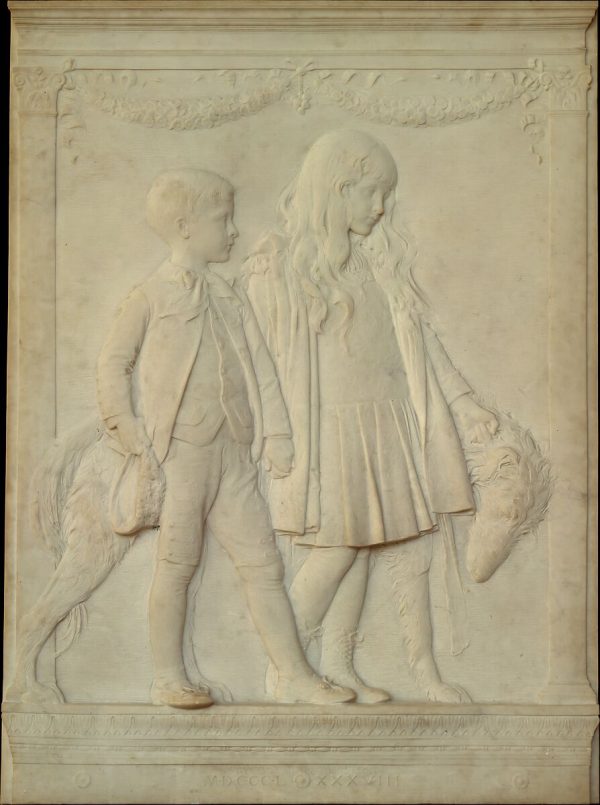
Saint-Gaudens worked on the Schiff children in New York, then carried the project north to Cornish, New Hampshire, where he spent his first summer modeling it. Slate reports that he made many clay studies of the pair, but something was still missing. The answer was Saint-Gaudens’ own Deerhound, Dunrobin, the family pet, and when he was added, the composition came together. In the finished relief, Frieda Fanny Schiff leads her younger brother Mortimer Leo by the hand beneath a floral garland. Her other hand rests on the collar of the dog.
Wearing our art critic hat, we note that Dunrobin stretches across the width of the panel and ties the scene together by being the strong horizontal line to counter the strong verticals of the children. His wiry coat is carved with a delicate, textured touch, a nice compliment to the floral framing up top. The National Trust for Historic Preservation, citing the Saint-Gaudens park, says the sculptor considered Dunrobin “the most beautiful dog” and used him in several works. One of them is a separate terra-cotta medallion of his head, dated 1884 and inscribed “Dunrobin.” A 1909 memorial exhibition catalogue lists it as a portrait of the dog used as the model for the Schiff relief. To all our misfortune, no photograph of Dunrobin is known, and no source we found gives his pedigree.
Technically, the panel is a bas-relief, though it bends the rules. Mortimer’s rounded foot extends over the edge of the plinth into the viewer’s space, and Frieda’s pleated dress is deeply undercut.
The 1885 bronze went to the Schiff home at Oyster Bay, Long Island. The bronze now belongs to the Saint-Gaudens National Historical Park. In 1905, Schiff paid for a marble replica for the Met. A Met publication says he gave several thousand dollars that December toward marble versions of three of the sculptor’s child portraits.
The Piccirilli Brothers carved the Met’s marble in 1906–7, and Saint-Gaudens, who was born in Dublin in 1848, died in Cornish in 1907. He never saw the finished piece. Today Dunrobin stands in Gallery 700 of the American Wing, carved in marble and measuring 68 7/8 by 51 inches (object number 05.15.3). He remains a long-legged stranger in a banker’s family portrait, and he is the only member of the group the sculptor truly called his own.
Image: Augustus Saint-Gaudens, The Children of Jacob H. Schiff, modeled 1883–85; carved 1906–7 by the Piccirilli Brothers. The Metropolitan Museum of Art, Gift of Jacob H. Schiff, 1905. Public Domain.
You will find Dunrobin in the 1888 AKC Stud Book. he was registered as owned by George Shephard Page, bred by the Duke of Sutherland, Dunrobin, Scotland. HIs sire was the great Torrom out of Loyal. the Duke’s gift to Page was in exchange for Page’s gift to Sutherlandshire of numerous black bass.
I should add that Saint-Gaudens did own two Deerhounds and the one in the portrait of the Schiff children is ‘Jack’, sired by Dunrobin with G.S. Page being the breeder.