
It’s been decades since the ‘wraparound’ skirt or dress was a style icon. In fact, if you were born after the 1980s, you won’t have experienced the enormous popularity of the Diane von Furstenberg jersey wrap dress that became de rigueur in professional work spaces, and later, as a sartorial symbol of independence. “It’s more than a dress, it’s a spirit,” said von Furstenberg of her iconic design. The dress that first hit the market in 1974 appeared in an ad in Women’s Wear Daily with the tagline “Feel like a woman, wear a dress!” Roughly two years after its launch, one million wrap dresses had been sold.

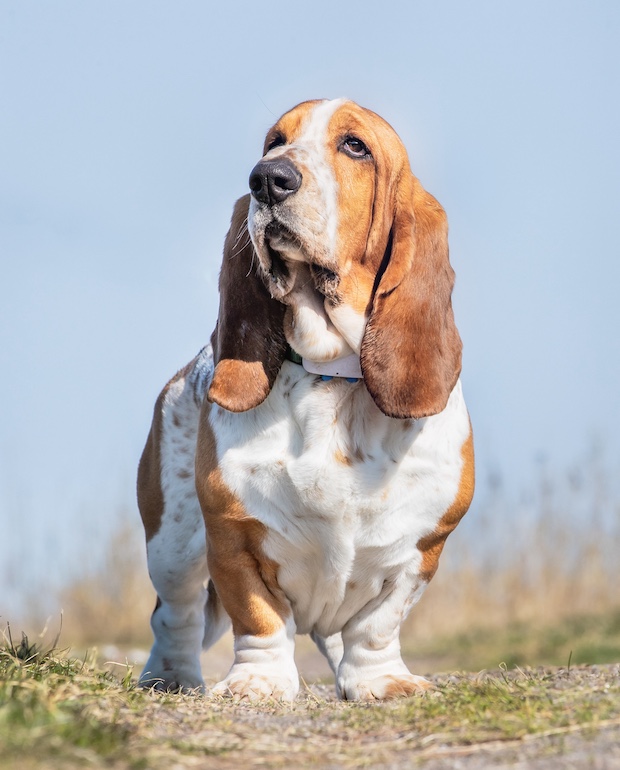
The wrap design is popular in some of our breeds, as well! Several achondroplastic breeds including the Dachshund and Basset Hound have what is called a “wraparound” front – a masterpiece of function where the wrists are closer together than the shoulder joints, a front designed to cradle and support a deep, heavy front. Unlike a straight, columnar front, these dogs’ forelimbs curve and set under a deep, projecting chest, literally hugging the ribcage and carrying its weight with efficiency. In Dachshunds, the wraparound front allows flex and fold for going to ground, hunting tight earths, and full-day tracking without breakdown. Basset Hounds, bred to be followed on foot, rely on an egg-cup front to keep the chest off the ground and ensure steady, efficient movement over rough terrain while carrying a capacious chest housing a strong heart and lungs for hours of methodical hunting. A slight outward turn of the feet is normal, but the strength of the pasterns is key as the wrap comes from bone placement, not weak wrists or sloppy angulation.
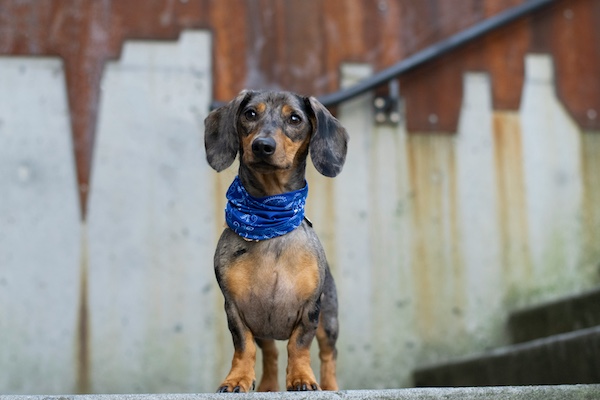
Photo by Katie Bernotsky
Viewed head-on, such a chest should fill the space between the forelegs, with the prosternum prominent within that “cup,” and the ribs presenting as full and oval, not flat or slab-sided. The forearms will curve around the ribcage, the elbows will be snug to the body, and the legs will be set under the dog, not tacked onto the outer corners of the chest.
Educational material for both these breeds and Bassets emphasizes that many fronts you see in the ring today are approximations at best, and that a correct or nearly correct wraparound front should be treasured and rewarded because it is fundamental to type, soundness, and endurance in the work these breeds were developed to do. In an article for ShowSight Magazine, Basset fancier, Sylvie McGee, tells us that the front assembly of the Basset Hound is one of the most challenging parts of the breed to understand, in part because loose skin can hide some key faults.
In a different article, Dachshund fancier, Ann Gordon, echoes similar sentiments when she mentions that this wraparound front is a unique front assembly not seen in many breeds, and consequently, some may have some difficulty in evaluating it correctly; it’s a situation exacerbated by the fact that not enough Dachshunds with correct fronts are being shown in present day conformation rings.
The wraparound. It’s a beautiful thing.
Image of a Basset Hound by Bigandt_Photography/iStock