
Pop quiz! Identify the word that appears in only one AKC breed standard that also appears in a cat breed standard.
Cue the Jeopardy theme music.
Give up?
From the Cavalier King Charles Spaniel AKC standard: Eyes: Large, round, but not prominent and set well apart; color a warm, very dark brown; giving a lustrous, limpid look. The word also appears in the breed standard for the Canadian Kennel Club: “Eyes: Should be large, round and set well apart. Colour should be a warm dark brown, giving a lustrous, limpid look.”
The word is limpid!
This marvelous word is one of our favorites because it is precise, vivid, compact – and to our ear, it sounds like what it means: clear, transparent and calm, like water you can see through. It is one of those words that isn’t easily substituted by another, perfectly capturing clarity and serenity in two syllables.
‘But wait!’ you’re thinking. We promised a cat. Indeed we did.
We like cats, but we are not “cat people,” and our feline fluency is limited. To our knowledge, there are three major cat registries, the Cat Fanciers’ Association (CFA), the International Cat Association (TICA), and the Fédération Internationale Féline (FIFe). Of them, the FIFe registers cat breeds which include our “word of the day,” limpid.
From both the Balinese and the Siamese standards: Eye Colour: Pure and limpid, bright, vivid blue;
The wording is exact because in FIFe’s own description, the Balinese is described as the semi‑longhaired counterpart of the Siamese, sharing essentially the same type but with a longer, silky coat.
To our eye, “limpid” is a great description, don’t you agree in looking at the photo below?
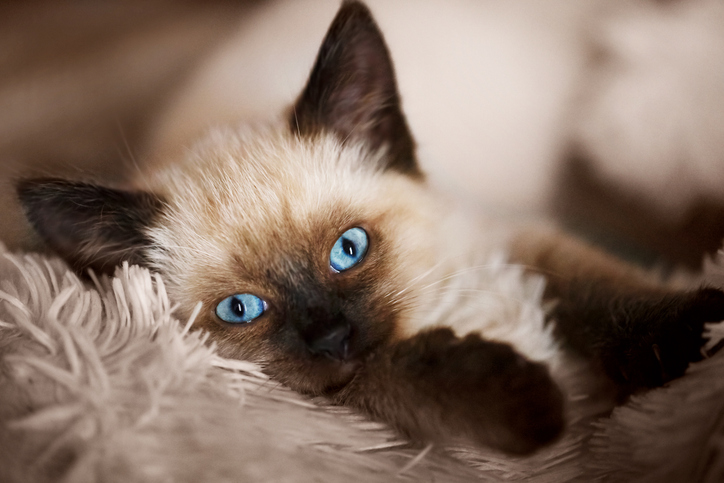
Balinese kitten by Oksana Osypenko iStock
The “limpid” eyes of Siamese and Balinese cats and Cavalier King Charles Spaniels come from different biological factors, but they produce a similar liquid, soulful effect. In Siamese and Balinese, the vivid blue color is due to a mutation in the TYR gene that also produces their color-point coat pattern; the blue comes from structural coloration rather than pigment. Their large, round, evenly pigmented irises with minimal central melanin, along with a clear cornea and lens, allow light to pass cleanly, creating the depth and clarity that breed standards describe as limpid (and we describe as incredible).
In Cavaliers, the effect comes from anatomy and pigmentation rather than structural color: the breed’s large, round, slightly domed eyes, set wide on the face, combined with very dark brown irises and a smooth, reflective corneal surface, produce a similarly deep, glassy, and expressive appearance. In both species, the overall “limpid” impression is amplified by contrast—between iris and surrounding features in cats, and iris and sclera in dogs—giving these two species their signature clear, liquid, and soulful “I’m yours” gaze.
Photo of Cavalier King Charles by tankist276/Depositphotos