
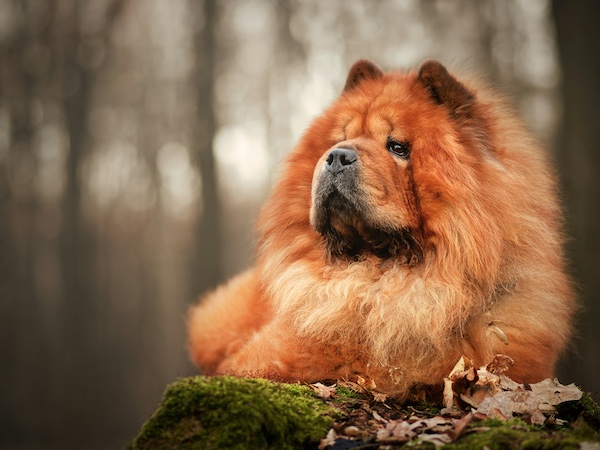
All dogs have brow bones. A dog’s frontal bone is ‘standard equipment’ in canine skull anatomy as it provides structural support for the skull and is where muscles and other facial features attach. Not every breed, however, scowls, and to our knowledge, only one AKC breed standard calls for an expression that is “essentially scowling.” It can only be the Chow Chow, a breed whose aristocratic bearing is punctuated by a lordly scowl. That lovable glare matters because without it, breed type is lost, and the dog risks looking like any other Spitz breed. The lack of a famous Chow Chow grimace also hints that structural deviations might be present—from incorrect skull shape to improper eye set.
The Chow Chow’s skull is broad and flat, both laterally and longitudinally. This expansive cranial surface provides the structural base upon which the breed’s distinctive features are built. Unlike some spitz breeds with rounded or domed skulls, the Chow’s flat skull facilitates a continuous brow line from forehead to muzzle, critical for the visual effect of a scowl. We opened with the fact that all dogs have brow bones, but in the Chow Chow, brow structure is defined by a broad, flat skull both side-to-side and front-to-back, providing ample surface for the marked brow and the padded button of skin above each eye. Deep-set, almond-shaped, obliquely set eyes on this broad platform, combined with the gradual transition from forehead to muzzle—features that cause the appearance of a slight frown even when the dog is relaxed—and a moderate-length, broad, and deep-boned muzzle, create the continuous brow line and soft tissue contours that give rise to the breed’s signature scowl and dignified, aloof expression, what the AKC and FCI standards call an “Oriental” expression.
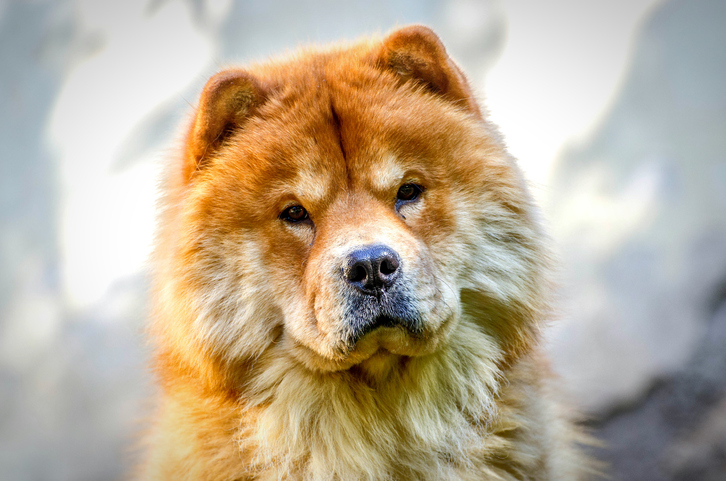
Close-Up of Chow Chow by EyeEm Mobile GmbH (not AI generated!)
In research conducted by Hechuan Yang, Guodong Wang, and colleagues from the University of Science and Technology of China, the Kunming Institute of Zoology, Yunnan University, and several international institutions, the genomes of nine Chow Chows from China were sequenced. Combined with whole-genome data from 37 other canids, the study confirmed that the Chow Chow is one of the most basal lineages—branching off early from the main ancestral line and retaining ancient characteristics distinctive to its origin.
We mention the breed’s ancient lineage for a reason. While some view the Chow Chow’s scowl as primarily aesthetic, its evolutionary persistence suggests it may have served functional purposes, such as reinforcing social hierarchies or signaling caution to other dogs while performing roles ranging from guarding to hunting and working, allowing the breed to communicate vigilance and authority in its historical environments.
Image: Chow Chow by Łukasz Rawa