The gait of the Scottish Terrier constitutes a hallmark of the breed. Unlike the square trot or walk, a Scottie’s forelegs don’t advance in perfectly parallel planes. Instead, as they extend forward, they incline subtly inward—a result of having a pronounced, broad forechest and relatively short legs. Because of how the Scottish Terrier is built—with that deep chest and short legs—the dog swings his front legs slightly to the side with each step and briefly shifts his weight to stay balanced. Notably, while the front foot extends beyond the chest, it never quite reaches the end of the dog’s nose, a subtlety marking the Scottie’s proportional precision. This results in a smooth, natural movement that may not be as showy or exaggerated as some other breeds, but it gets the job done by helping the dog maintain good balance.
Here we get to a question we ask a lot on these pages: Why? Why does this structure help the dog do what its original purpose was, which was to hunt and control vermin on farms and estates in the Scottish Highlands. The Scottie’s unique conformation allows the dog to maintain a stable and balanced posture while digging and navigating in tight spaces where critters like badgers, foxes, and rats live. His broad chest provides ample room for the heart and lungs, ensuring the dog has the stamina and strength necessary to take the ‘fight for supremacy’ underground. Short legs and muscular hindquarters supply the power and drive needed to spring from rock to rock, or to pull unwilling (and often teeth-snapping) prey backward from its hole with the determination for which the Scottie is known.
Critical for a terrier that needs to throw dirt sideways rather than under its body is the inward incline of the forelegs and the compact, and close foot placement that such a chest and leg structure supports to move dirt while digging. Furthermore, the structure of the back legs – well-bent stifles, strong thighs, and straight hocks—ensures that the Scottie can produce a powerful, square, and true drive that propels the dog’s body forward with both agility and force. This configuration absorbs shock and maintains the dog’s center of gravity as it moves, preventing unnecessary strain or imbalance.
In short, form following function.
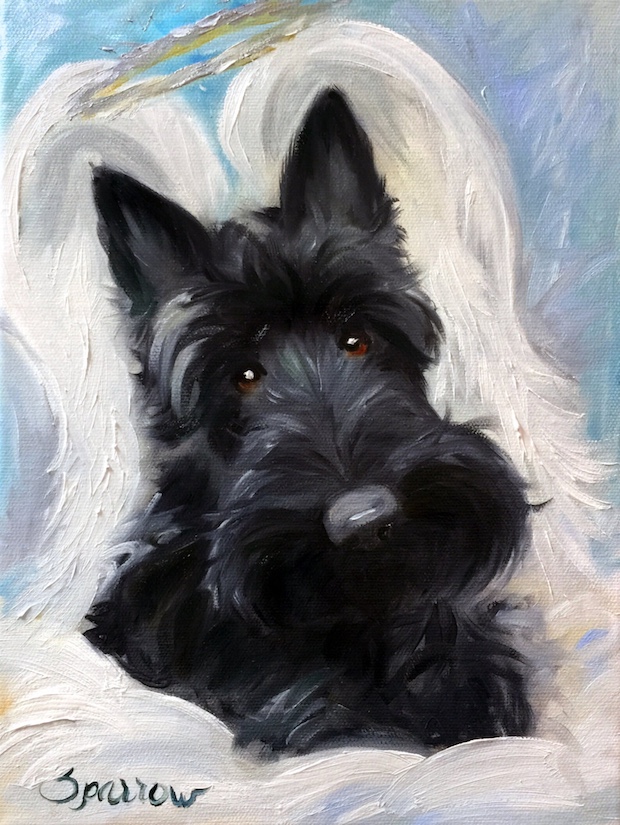
Image: Mary Sparrow – HangingtheMoonShelby
www.marysparrowsmith.net
www.etsy.com/shop/HangingtheMoonShelby