Scroll down to see the most highly viewed YouTube video ever according to stats:
As of 2025, “Baby Shark Dance” by Pinkfong has had over 16 billion views.
We don’t get it. Then again, maybe it’s a young parent thing.
We narrowed our search to “most viewed dog video ever on YouTube.” It’s this one:
Cute, but to be honest, what captivates our interest is a video like the one below:
Amazing, right?
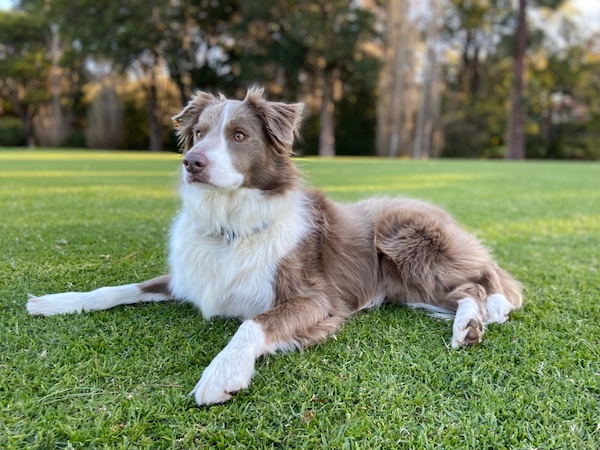
As talented as these dogs are, did you know that the breed’s rarest and most distinctive color expression is lilac?
The lilac Border Collie (an accepted color per the AKC) is notable for its muted lavender tone and almost subtle metallic sheen.
Right now, we know you’re asking, “Hey NPDD, genetically speaking, what causes the lilac color?”
Well, reader, it’s the combined influence of two recessive alleles acting on eumelanin pigment.
A dog must be homozygous for both the brown (b) allele at the B locus and the dilution (d) allele at the D locus, giving a genotype of bb dd. The brown allele modifies black eumelanin to brown (commonly referred to as “chocolate”), and the dilution allele further lightens this pigment to the characteristic lilac shade. The dilution extends beyond coat color, affecting skin and ocular pigment as well—typically producing a lighter nose leather and eyes ranging from light amber to hazel.
In layman’s terms, this means that for a dog to be lilac, it needs to get two copies of both the brown and dilution genes from its parents. The brown gene turns a black coat into a chocolatey brown, and the dilution gene then lightens that brown to create the unique lilac shade. This lightening effect doesn’t stop at the hair/fur—it also makes the nose and skin lighter, and the eyes can be a soft amber or hazel instead of dark brown.
Because both the brown and dilute alleles are recessive, each parent must carry both for lilac offspring to appear. The likelihood of this combination occurring unintentionally is low, which explains why most lilac Border Collies are the product of planned matings where color genetics are carefully tracked.
In contrast, the classic black-and-white phenotype with which most of us are familiar dominates the breed, but red, blue, and merle variants are also common. Lilac remains uncommon because the necessary alleles are unevenly distributed among lines; some working or trial lines may lack one or both altogether. Without deliberate selection for color, the probability of producing a bb dd individual is minimal.
We did try to find statistics on the rarity of the color, but registration data on its frequency are unavailable, at least to us. That said, anecdotally, estimates suggest that lilacs account for well under one percent of AKC-registered Border Collies, making them arguably the rarest of the recognized color variants.
Beyond its visual appeal, the lilac Border Collie serves as an elegant example of how subtle genetic interactions shape phenotypic diversity within the breed—reminding us that even in a working dog renowned for intellect and instinct, the nuances of inheritance still hold surprises.