The Chinese Shar-Pei is often reduced to a nickname—the dog with the wrinkles—but that shorthand barely hints at what those folds actually represent. Modern genetics has shown that the breed’s distinctive skin results from a duplicated stretch of DNA just upstream of HAS2, the gene encoding hyaluronan synthase 2. Extra copies of this regulatory region drive unusually high production of hyaluronan—a gel-like molecule that gives connective tissues structure and hydration—packing the dermis and creating skin that is thick, substantial, and inclined to fold. It is a textbook example of how a subtle change in gene regulation can reshape an entire outline.
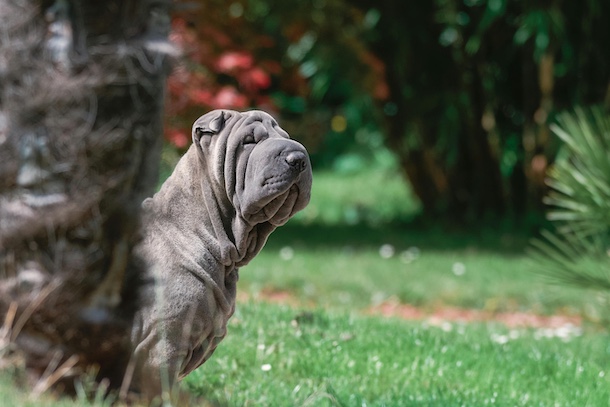
Structurally, the effect is unmistakable. Rather than lying flat, the skin behaves like fabric cut with extra allowance, settling into corrugations over the head, neck, and joints. Puppies are typically the most wrinkled, with folds redistributing as they mature and often concentrating on the head, neck, and withers in adults. Variation exists between bloodlines, and occasionally a Shar-Pei will show loose skin around the hocks or pasterns—an expression breeders casually call “baggies.” It is neither inherently desirable nor inherently undesirable; it simply reflects the range of expression within the trait.
Historically, that substantial skin was more than an aesthetic curiosity. As a multipurpose farm and guardian dog, loose, padded skin may have offered practical advantage, making it harder for an opponent to secure a damaging grip and providing a measure of protection to vital structures. Long before “copy number variation” entered the scientific vocabulary, people were assigning both meaning and utility to the same physical feature.
In southern China, the Shar-Pei’s wrinkles also carried symbolic weight. Folklore held that the folds could confuse or frighten malevolent spirits, extending the dog’s role as guardian beyond the physical household. Certain forehead furrows were said to resemble auspicious Chinese characters associated with longevity or good fortune, turning the dog’s face into something like a living talisman. What science now explains in terms of hyaluronan accumulation was, for generations, read as meaning written directly on the skin.
For knowledgeable breeders and owners, that dual perspective matters. Understanding the molecular basis of the Shar-Pei’s skin—how HAS2 regulation shapes dermal structure—helps inform responsible breeding and long-term decisions about type and health. At the same time, the breed’s enduring appeal cannot be separated from the cultural interpretations that helped preserve and define it. The Shar-Pei carries both narratives at once: one encoded in DNA, the other in tradition. Together, they explain why this breed remains instantly recognizable—and far more complex than its wrinkles alone.
Image of a Chinese Shar-Pei by Thierry Rossier