In the world of dog breeds, not knowing the language of a breed’s country of origin can sometimes lead to a breed’s function being misunderstood. We point to the word, “ovcharka” to illustrate .
Between the FCI, AKC, and UKC (a few registries we picked at random), the Caucasian Ovcharka, Central Asian Ovcharka, South Russian Ovcharka are either fully recognized, or are part of a foundation stock service that allows them to continue to develop while providing an avenue to maintain breed records.
There are, however, more “ovcharka breeds” that are either not standardized, or they aren’t recognized by major kennel clubs. They include the North Caucasian Ovcharka, Volkodav Ovcharka, Armenian Ovcharka, Georgian Ovcharka, Transcaucasian Ovcharka, Kirgiz/Kyrgyz Ovcharka, and the Tajik Ovcharka. Some of these are landrace variants that may never be recognized, but others might get there one day.
Because every one of these ovcharka breed, recognized or not, is a large to giant-sized dog, some people assume that “ovcharka” refers to the breed’s size, the way “mastiff” or “mountain” in a breed’s name suggests a large breed.
In the case of the ovcharka, it doesn’t.
In Russian, “овчарка” (ovcharka) literally means shepherd dog (from овца / ovtsa = sheep). It’s possible that the reason English speakers often associate Ovcharka with big, intimidating livestock guardians is because the three best-known FCI breeds that retain “Ovcharka” in their English names — Caucasian, Central Asian, South Russian — happen to all be large breeds.
We’ll cover each of these ovcharka breeds in the future, but we felt that a good jumping off point is to explain the word, itself.
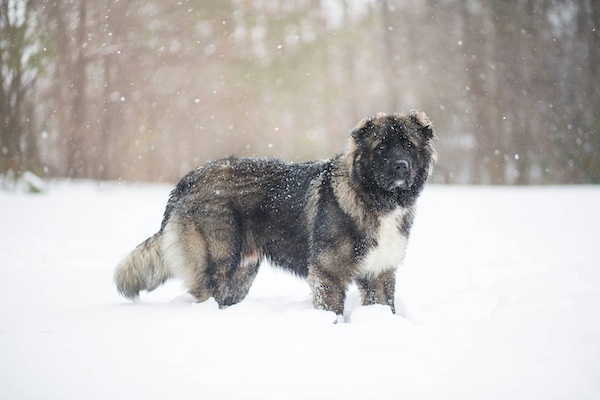
Image of Caucasian Ovcharka in snow by Reba Spike