
There are a couple of lines in the AKC breed standard for the English Cocker Spaniel that are worthy of a question we ask a lot on these pages. The question is “why.”
Why does the standard call for “forechest well-developed?”
Why does the standard write: “Upper arm set well back, joining the shoulder with sufficient angulation to place the elbow beneath the highest point of the shoulder blade when the dog is standing naturally.”
And why did the English Cocker Spaniel Club of America include in its Illustrated Guide a box intended to emphasize this sentence (the bold print is ours): “*Judges must understand that a correctly made front is an integral part of breed type. The correctly made front assembly, with a protective forechest, is a necessary essential for pushing into dense and unforgiving brush and thickets. The English Cocker’s front legs must be well placed underneath the dog to support his substantial body and maintain balance while carrying game.”
Let’s look at an image of an English Cocker Spaniel with a line we added to illustrate: “Upper arm set well back, joining the shoulder with sufficient angulation to place the elbow beneath the highest point of the shoulder blade when the dog is standing naturally,” and “legs must be well placed underneath the dog.”
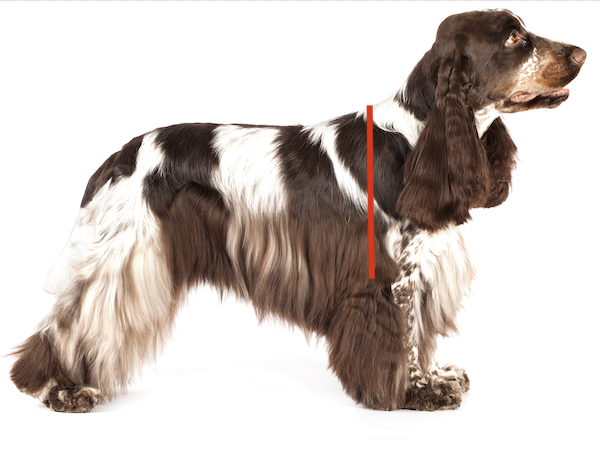
Allowing for coat, this is a guestimate
The answer to the questions we posed earlier has everything to do with this breed’s original function.
The English Cocker Spaniel is a sporting dog originally bred in England to hunt the Eurasian woodcock, a medium-small game bird weighing just under a pound. When the breed was brought to the United States, it adapted to flushing and retrieving a similar range of upland game birds, but of varying sizes such as the American woodcock, pheasants, and quail. Having a well-developed forechest, and legs well situated under the dog allowed the ECS to maintain balance, power, stamina and agility while carrying birds that are only a small fraction of its own weight, all while working efficiently in thick underbrush and dense cover.
To put it into context, a human of average weight, carrying a proportionally equivalent load would mean carrying around 5 pounds in their mouth while moving through thick brush. We’d pay good money to see certain people do this, but we digress. To do this effectively, a human would need to have legs positioned directly under their body to support the center of gravity efficiently, much like the ECS’s build, to prevent themselves from tipping or losing balance. Additionally, that human would require a compact and sturdy frame with strong core and limb muscles, a lower center of gravity, and body proportions optimized for balance and maneuverability in dense terrain. These adaptations would allow the person to move nimbly and maintain stability while carrying the load, replicating the Spaniel’s ability to carry relatively heavy game through challenging environments.
Easier said than done (for a human).
We can’t forget the importance of the dog having sufficient angulation that places their elbow beneath the highest point of their shoulder blade. When the elbow is positioned properly under their shoulder blade, the dog has a well-balanced front assembly that allows for good reach and smooth, efficient movement. This angulation also enables the shoulder muscles to support the joint effectively, reducing concussion and strain during activities like running, jumping, or galloping – common motions in hunting spaniels. Additionally, proper elbow placement helps keep the elbows tight to the body and prevents excessive movement or looseness, critical for endurance and performance in a working dog.
The structure of the English Cocker Spaniel’s front assembly is far more than a matter of appearance—it is a fundamental adaptation rooted in the breed’s historical function as a versatile hunting companion, and authors of the breed standard understand this. Emphasizing features such as a well-developed forechest, proper angulation, and correctly placed legs, underscores how form directly supports function – and this understanding almost always answers the question “why.”
In future posts, we’ll cover the rest of this special breed’s structure.
Images by © Lilun/Dreamstime