Gobbledygook. Is there a word in the English language that is more fun to say – or is often pronounced more often without the requisite ‘d’ than this one?
The term, as anyone who uses it knows, refers to language that is confusing, unnecessarily complicated, and obscures meaning rather than clarifying it.
Fun fact: In 1944, Maury Maverick, a Texas congressman frustrated with bureaucratic mumbo jumbo, coined the word based on what he thought sounded like a turkey gobbling. The irony is that gobbledygook has become a common word in discussions about confusing language which, all by itself, makes it a good example of the very thing it criticizes.
The dog world is replete with words and phrases that non-dog people find head-scratching, and most of us in that world can come up with ten examples without even trying. There are, however, words that even fanciers might not know because they’re either archaic, niche vocabulary specific to a breed, or so obscure that they function as ‘gobbledygook’ even to seasoned exhibitors. These words are the verbal equivalent of a badly written bureaucratic memo that sends everyone back to the glossary.
And we love to share them with you. Why?
Because we’d hate to lose the foundational words that early breeders and standards used. Mind you, we’ve replaced some of those terms with updated terms of our own that may baffle future fanciers, and “Grinch feet” is a good example.
We are hard pressed to find a current document that uses the term, “fins,” to describe what grinch feet mean today, a specialized descriptor for the profuse, sometimes wispy hair that grows out from the feet, usually from between the pads. As far as we can tell, one of the first sources to use the word was the “Glossary of Technical Terms Relating to Dogs,” written by Vinton Breese, a famed AKC judge and columnist for Popular Dogs in the early 20th century. He defined “fins” as the “wing-like” or “excessive” fringe trailing from the feet, particularly in the longhaired Dachshund and some sporting breeds.
A pet owner may quite like the grinch feet on their dog, but for the fancier, hunter, and show judge, there are a number of reasons why, in some breeds, fins (which we’ll use for the remainder of this post) aren’t appreciated.
To a judge, excessive fins at the feet disguises the true foot shape and tightness of a dog’s paw and can make a good foot look splayed; that, in turn, impacts the silhouette of the dog and distracts from the breed’s characteristic lines.
To the hunter, fins trap mud, burrs, seeds, and debris that can lead to mats and tangles and make walking, let alone hunting, uncomfortable. In the winter, moisture and snow in the fins freezes into ice balls, and to the dog, they might as well be small rocks between their pads—they cause as much pain.
Damp hair in the fins can lead to the growth of bacteria and yeast, and that can lead to pododermatitis, an inflammation of the skin in the paw. Trimming fins allows hair and skin to dry faster.
To the show exhibitor AND a hunter, fins that are too profuse result in a loss of traction. The dog essentially walks on its own hair rather than on its pads, and as any fancier can tell you, gaiting a dog on a smooth surface is hard enough; gaiting a dog walking on its own hair on a cement floor leads to the risk of slipping for both the handler and the dog.
In the end, “fins” is one of those wonderful old bits of dog-world gobbledygook that deserves to be remembered because the language early fanciers used is part of a shared history. When terminology drifts into obscurity, we risk losing not just colorful words, but the practical wisdom they were meant to convey.
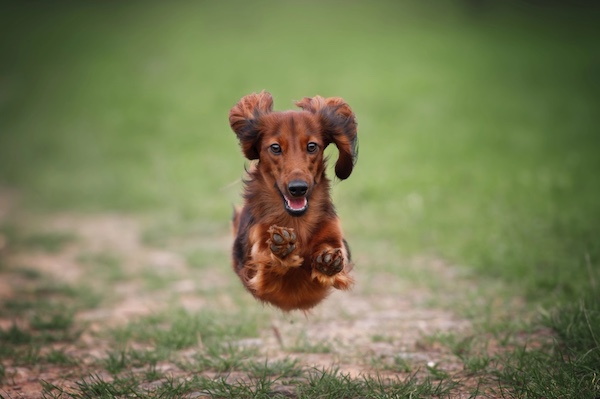
Image of a Longhaired Dachshund by Kristina_photo/Depositphotos