It’s probably not too soon to make plans for the World Beard and Moustache Championships. Scheduled for August 13–16, 2027, in Blackpool, England, the biennial event is the authoritative and definitive event to determine the best representative facial hair styles in the world. There are eight official facial-hair categories that span three main brackets — Moustache, Partial Beard, and Full Beard, and while the exact lineup can vary slightly by year and location (sometimes, there is Trend Beard category), there are usually a total of eighteen classes that approximate the list below:
Moustache Categories
Natural Moustache – natural growth, minimal styling.
English Moustache – long slender moustache with tips pulled to the side.
Dali Moustache – long, slender, tips arching upward.
Imperial Moustache – small bushy moustache with upward-arching tips.
Hungarian Moustache – big and bushy, starts mid-upper lip.
Freestyle Moustache – creative designs not fitting other moustache classes.
Partial Beard Categories
Natural Goatee – beard only on chin/lip area.
Chinese (Fu Manchu) – moustache with shaved chin and long downward tips.
Musketeer – slender moustache with small pointed beard.
Imperial Partial Beard – hair only on cheeks and upper lip.
Sideburns Freestyle – styled sideburns with shaved chin.
Alaskan Whaler – beard without moustache.
Full Beard Categories
Verdi – short, round beard (≤10 cm).
Garibaldi – broad, full, and round (≤20 cm).
Natural Full Beard – unstyled full beard.
Natural Full Beard with Styled Moustache – natural beard, styled moustache.
Full Beard Freestyle – creative full beard styles beyond other classes.
Trend Beard – short carved beard (introduced in some years).
The connection to purebred dogs is obvious: collectively, the terms “beard” and “moustache” appear more than forty times across AKC breed standards spanning all seven groups. One term, however, is uniquely bound to a single breed—the Poodle. The impériales, the elongated facial furnishings framing the corners of the mouth, echo the human Imperial moustache that flourished in 18th-century Europe. Whether worn by men or meticulously scissored onto dogs, impériales served the same purpose: refinement, flourish, and a visual declaration of style.
Kaiser Wilhelm II, the last emperor of Germany, was famously associated with the Imperial moustache and is widely credited with popularizing the style from which it took its name. Bold and full, it was a daring look—yet one defined not by sheer mass, but by emphasis at the corners, where the hair was trained outward and upward into distinct, ornamental points. It is this deliberate projection and pointed expression, rather than strict anatomical placement, that links the human Imperial moustache to the Poodle’s impériales, later translated in canine grooming as the small, pointed beard furnishings of the underjaw.
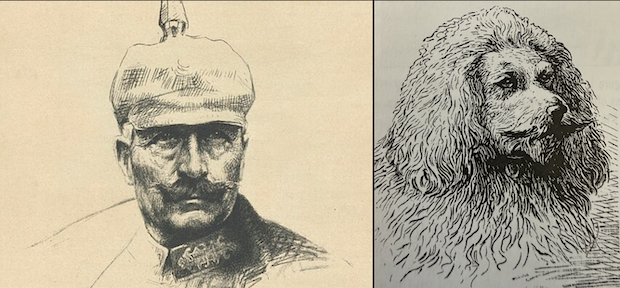
German Emperor Friedrich Wilhelm II by Wilhelm Schodd is in the public domain; “Poodle with moustache and imperiale, Illustrated Sporting and Dramatic News, July 1880, also in the public domain
Demoiselles (canine hairstylists) of the 18th century groomed Poodle coats to include wildly creative designs shaved into the dogs’ coats: Flowers fleurs-de-lis, coats of arms, etc. This was in addition to the jaunty moustaches, piled-high pompadours, and elaborate coiffures. Grooming a Poodle at that time was considered an extension of toilette culture. Noteworthy is that although France and Germany were rivals at the time, big, styled moustaches were a shared European military fashion, not just a “German” symbol. Officers in France, Germany, Britain, and elsewhere all wore exaggerated moustaches as signs of virility and rank, and these styles spread through art and popular culture regardless of politics. When this Poodle was illustrated with a Kaiser‑like moustache in July 1880, Wilhelm II was a 21‑year‑old Prussian prince, so the artist was echoing a recognizable imperial officer look rather than expressing sympathy with Germany.
The Poodle’s impériales live at the intersection of historic Poodle grooming and human fashion history: a playful, almost satirical nod to the same martial moustache culture that marched across European battlefields and parade grounds, neatly redirected onto a canine canvas. Today, competitions like the World Beard and Moustache Championships (and trends in Poodle grooming) remind us that the fascination with creativity, precision, and personal expression, endures—whether on person or Poodle.
That said, it’s important to remember that Poodles were/are water retrievers. Hunters shaved the face, hindquarters, and legs to prevent the coat from becoming heavy and waterlogged, which allowed the dog to swim more efficiently. The “mane” was left only to protect the vital organs from the cold water. As the poodle moved from the marshes to the French courts, the functional “clean shave” was modified for aesthetic flair. Stylists began leaving the moustache and imperiale specifically to mimic the facial hair of the noblemen who owned them. The modern result, some opine, is that eventually, the “clean-shaven” face of the hunter won out as the official breed standard because it was seen as more elegant and practical for showing the dog’s true expression.
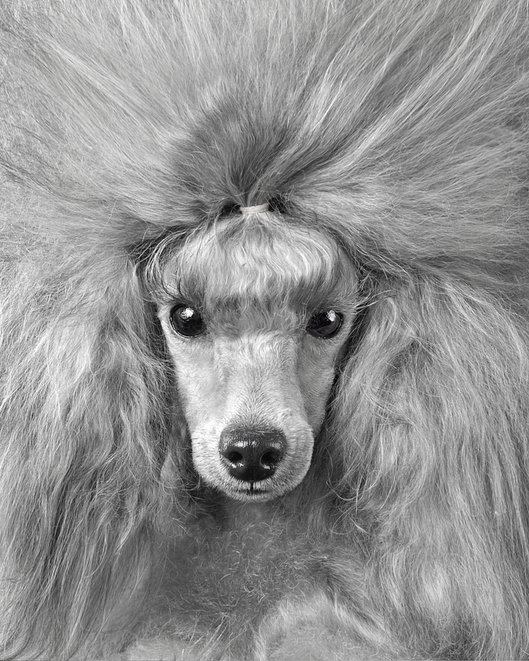
Image of (moustacheless) Poodle by eAlisa/iStock