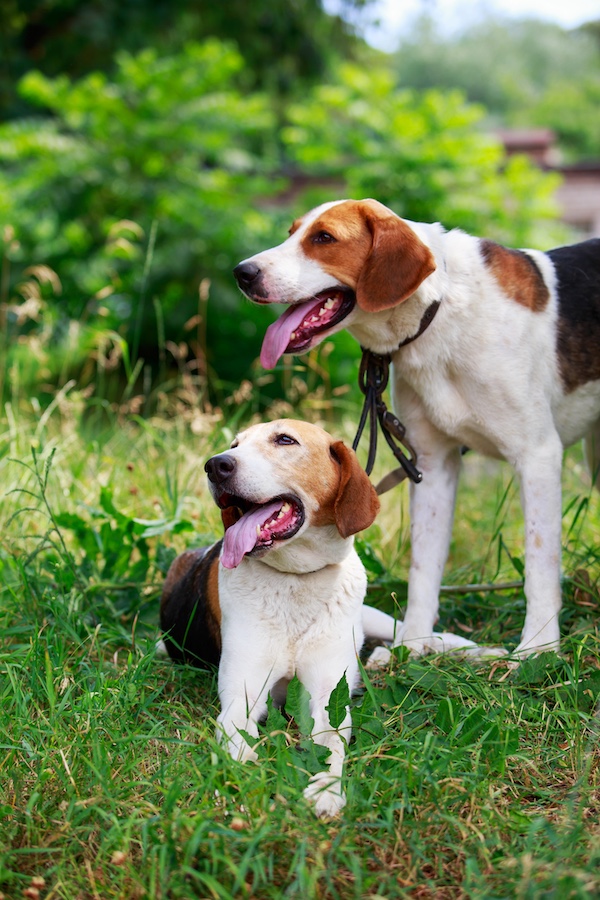
On the way to writing about the Moscow Watchdog, we got sidetracked by one of the less familiar breeds credited in its creation—the Russian Spotted Hound. Detouring down a rabbit hole always seems to happen when we come across a name that sounds fabricated, and we feel compelled to investigate sources for authenticity. We learned that the Russian Spotted Hound is indeed authentic, and that the breed played a significant role in the development of the Moscow Watchdog.
The Moscow Watchdog will have to wait.
Selective breeding wasn’t pursued until the 1900s, and the first breed standard not established until 1925 – and in Soviet-era cynology, the hound was recognized as a separate type. But until 1951, the breed was known as the Anglo-Russian Hound, reflecting its mixed heritage. Only later was it renamed “Russkaya Pegaya Gontchaya” (Russian Harlequin Hound) to emphasize its distinct Russian identity, but in the years following, the breed came to be called, simply, “pegaya,” meaning “spotted” or piebald in Russian.
Among hunters, the breed has earned another nickname: the “Red Chase Dog,” for being a specialist in hunting “red game” such as foxes and wolves. That said, this is a gregarious, loyal, and affectionate dog that gets along with children and other dogs. Not to be faulted for its genetics, however, pegayas should not be blamed for being highly vocal, highly energetic, and possessing a strong prey drive that makes cats and small pets target practice (in the dog’s mind).
These are qualities of which potential owners should be aware, but there may be one more: Good luck finding one. The Russian Harlequin Hound is still in existence, but it is a rare breed found primarily in Russia and in parts of the former Soviet Union. It’s not widely recognized by major international kennel clubs like the FCI, though it is acknowledged by the Russian Kennel Club and can be occasionally spotted at Russian dog shows, such as those hosted by the Moscow Society of Hunters and Fishermen.