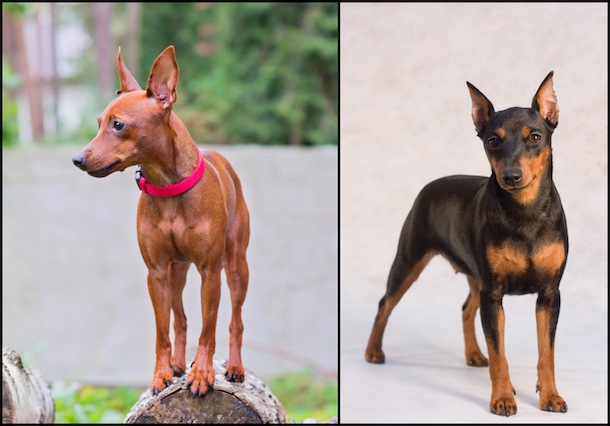
We can’t stress enough that the images you see here are of two different Miniature Pinschers who, to our knowledge, have no shared pedigree. The photographs were found on a stock photo service and chosen only for the dogs’ respective colors, and not for their adherence to the breed standard. We’re displaying them side by side not to demonstrate that color and markings can create optical illusions, but to help explain why the illusion occurs at all. If only we could use the exact same dog and swap its coat color for demonstration, but in lieu of that, we ask that you go along with our best effort to illustrate this concept.
For the sake of brevity, we’ll refer to Chocolate and Rust, Black and Tan, and Black and Rust Miniature Pinschers as “marked Min Pins.”
According to research on animal coloration, high-contrast patterns can exaggerate the perceived size of certain body parts by creating visual boundaries. It is a well-known principle in design that the color black absorbs light and makes certain body parts look bigger by creating defined visual edges. In the marked Min Pin seen here, the black makes the top of the dog’s head appear wider. The rust-red spots reflect light and taper the lower part of the dog’s face while amplifying the contrast with the darker skull which really emphasizes the dog’s head width. Rust-red “eyebrow” marks above the eyes not only draw our focus upward and reinforce that broader skull look, but also reflect more light and create a tapering effect.
The solid red dog, with its uniform color, lacks these contrasting lines, causing the dog’s head to blend together and appear narrower and more streamlined. Put another way, the solid color removes visual cues that make the head stand out, so it ends up looking sleeker and less wide even if it isn’t. Without distinct “boundaries,” the skull and muzzle just blend together and diminish the width perception.
This illusion also influences expression because high-contrast markings around the eyes makes them appear more expressive and the muzzle more defined, contributing to a perception of alertness and intelligence.
Markings also accentuate a Min Pin’s build: From the breed standard: “Topline – Back level or slightly sloping toward the rear both when standing and gaiting. Body compact, slightly wedge-shaped, muscular.” The combination of dark and light areas on the marked Min Pin creates a three-dimensional effect under natural lighting. The black absorbs light, while the rust-red reflects it, adding depth that enhances the perception of a sculpted, refined form. The red Min Pin, with its uniform coat, reflects light more consistently and ends up with a “flatter” appearance.
Flatter can seem less muscular, and to the person sitting ringside, the solid color dog may lack the well-developed forechest that the “two-toned” dog has courtesy of two rust-colored “landmarks” on his chest. The lighter spots reflect more light and draw attention to the underlying muscle structure that mimics the natural contours of the chest muscles. Simply put, the spots create the illusion of a well-developed forechest that has greater substance than the stag red Min Pin.
It doesn’t end there. The segmentation of the black and rust-red pattern can give the impression of a taller, more elongated frame and emphasize the transition between the body and legs, making the legs seem proportionally longer relative to the torso.
These design principles are noted in the Miniature Pinscher Club of America’s Illustrated Guide when it states (to paraphrase) that all colors must be judged equally, and that optical illusions can make one dog look to be of less quality than another.
Mind you, the dogs we’ve chosen for their color may actually be as flat/muscular/narrow/refined or sculpted as they appear, but that isn’t the point. The effects of color and markings are rooted in principles of visual perception and align, but there is one critically important conclusion to be drawn from this post: the importance of a hands-on examination of a dog one is evaluating. Fanciers of heavily coated breeds know all too well the importance of “digging into” a dog’s coat to properly assess structure, but if our post has suggested anything, it is that “going over” a dog is immensely important in certain short coated breeds, too.
Anyone interested in learning more about the optics of color may want to investigate a couple of our sources, including William Lidwell’s Universal Principles of Design, and Tim Caro’s The Adaptive Significance of Coloration in Mammals.
Image: Photo of Miniature Pinscher on white background by ©Alexandr Ryzhov/Dreamstime;Photo of stag red Miniature Pinscher from Deposit Photo