Most of us can detect one language from another, but when *we* overhear a tongue that seems to defy identification, it always turns out to be Welsh or Irish.
Welsh, one of Europe’s oldest languages and still widely spoken in Wales, is totally phonetic. That said, long words can be packed with double consonants that present sounds not found in English. Oh, and the vowels! Welsh has seven vowels and is famous for having long, vowel-rich words like Llanfairpwllgwyngyllgogerychwyrndrobwllllantysiliogogogoch, a town name often shortened to “Llanfairpwll,” which, according to an AI, is pronounced Hlan-VIRE-poolch.
For our money, however, Irish may be an even harder language because it uses consonants, vowels, and combinations that English almost never does. Many Irish words are spelled in ways that give no clue as to how to say them, and if you doubt this, take our little quiz below on the pronunciation of a few common Irish names:
Aoife is one of the most popular baby girl names in Ireland today. How do you say it? Another traditional Irish girl’s name is Caoimhe. You say it how? And things don’t get easier with boy names. How would you say Ruaidhri? Or how about Tadhg?
Solutions: Aoife, according to a poll, is ranked among the hardest names to pronounce because in the Irish language, vowels have different sounds than in English. It is pronounced EE-fuh.
Caoimhe is pronounced KEE-vah or KWEE-vah because it follows the rule of pronouncing “ao” as a long “e” (as in “tree”). The consonant pair “mh” is sometimes pronounced as “v” in Irish, which adds to the complexity of this name.
You would say Ruaidhri as RUE-ree or RUR-ree, while Tadhg is said as “Tige” (to rhyme with “tiger,” but without the “r”).
See what we mean?
So far, our opening salvo is utterly unrelated to dogs, but Welsh and Irish are, and in this post, we share a few fun facts about the Irish Kennel Club and the Welsh Kennel Club.
Some readers may already know that the origins of the Irish KC was organized in direct opposition to the United Kingdom’s Kennel Club and reflected Ireland’s push for independence. More than a dog event, the first show not only broke after-hours curfew, but both Irish revolutionaries and British officials navigated dangerous streets to assemble under cover of night, people on either side of a political issue who stood side by side as exhibitors in the ring, united in their enthusiasm for canine excellence.
Putting a damper on the festivifun was James O’Mara, an Irish Nationalist MP who grew alarmed by the amount of booze that consumed in Ireland on the blessed St. Patrick’s Day, and during Lent, no less! His bill to the House of Commons made it compulsory for all public houses in Ireland to close on March 17, and from around 1900 to the early 1970s, it was illegal to sell alcohol on that day. But get this: Irish Kennel Club members got an exception; they got to enjoy adult beverages at the club’s annual show. According to legend, this was a big recruitment draw, and even the poet, Brendan Behan, is said to have “borrowed” a dog off the street to be able to sneak into the members’ lounge.
Those earliest shows reflected the times. The entry catalog was a roll-call of contemporary politics: Though we don’t know their breeds, dogs named “Munster Fusilier,” “Trotsky,” a “Markavich” (after the revolutionary Countess Markievicz), and “Convict 224,” the Kerry Blue Terrier belonging to the pivotal symbol of Ireland’s struggle for self-determination, Michael Collins, were all there. The trophy Collins donated (the Michael O Coileain Perpetual Cup) is still offered today!
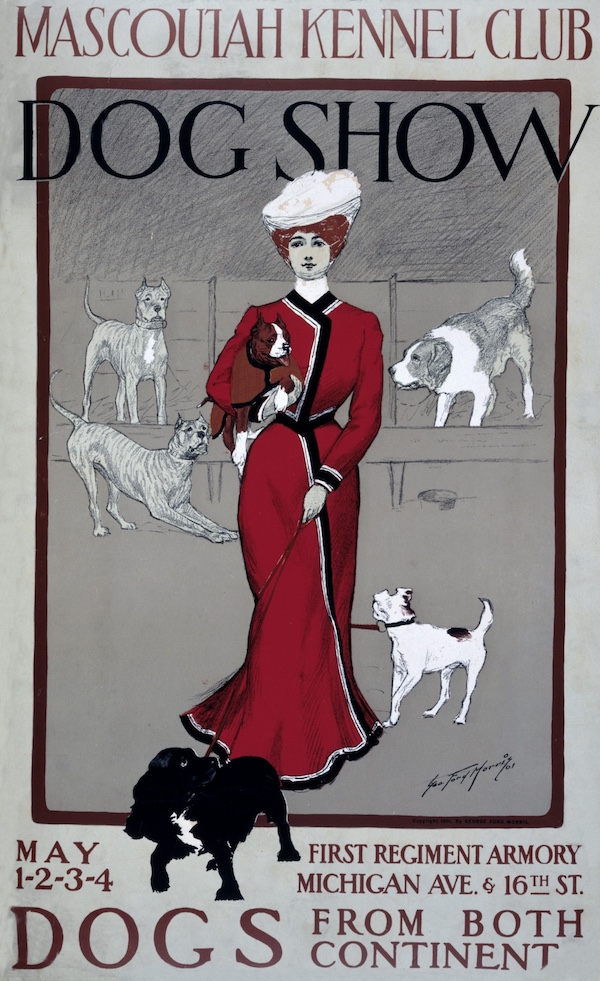
Our image is neither from the Irish KC or Welsh KC, but it is a vintage poster in the public domain