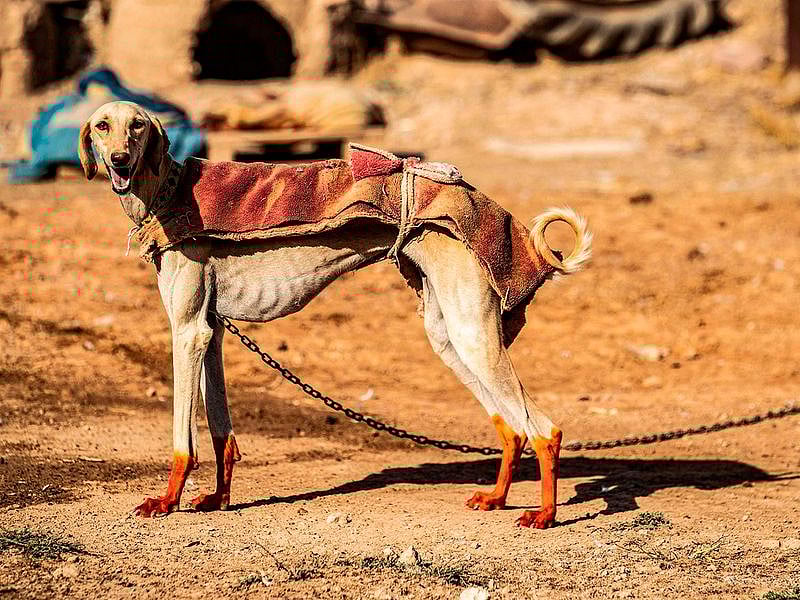
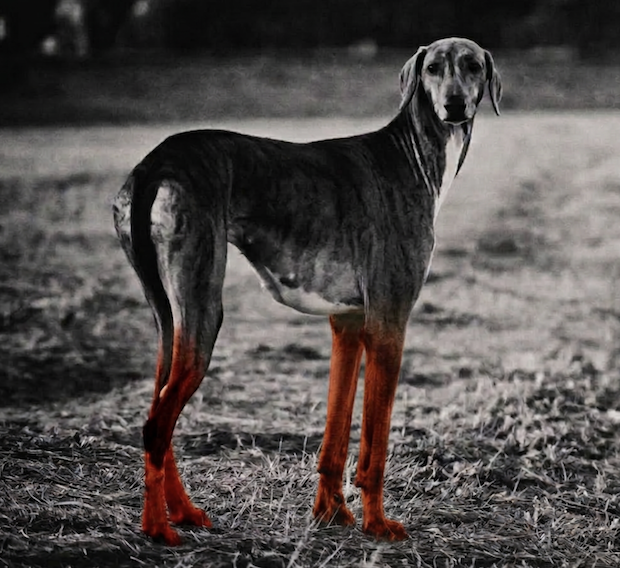
There was no eureka moment, no single recorded moment of discovery.
But we know from textual evidence and archaeological finds, including 4th‑millennium BCE burials, that the Lawsonia inermis plant has been used in North Africa for about five to six millennia. Medical texts like the Ebers Papyrus list the plant’s use in ritual, cosmetic, and medicinal contexts for humans—ample time for people to learn that preparations from it could cool, soothe, and protect cracked skin on their heels and nail beds, and provide relief from fungal rashes and small wounds. Its use in ancient Egypt is also well attested in personal grooming and funerary practices, reinforcing its longstanding cultural significance.
It is pure conjecture on our part that at some point within the last 500 years—to the extent that evidence exists—humans reasoned that if it helped them, the plant might help their camels, horses, livestock, and dogs. The earliest unambiguous images of red‑legged Salukis in Persian miniatures date to around the fifteenth to sixteenth centuries CE, thousands of years after the first human evidence. These artworks, often associated with Safavid‑era manuscript illustration, provide some of the clearest visual documentation of the practice applied to animals. In subsistence and pastoral cultures, after all, anything that kept a working animal sound was quickly tried.
It was centuries before science could determine that the substance, once dried, ground into a fine powder, and mixed with a liquid to form a thick paste, has anti‑inflammatory, anti‑fungal, and anti‑bacterial effects. It can help prevent or soothe skin issues like ringworm, “hot spots,” and yeast infections on paws and ears. In desert hunting dogs, applying it to the feet and lower legs is described as helping protect against abrasions and cracked pads when running long distances on rough ground or hot sand—certainly the “workplace” of desert sighthounds. Indeed, veterinary and regional sources from the Middle East note that dyeing the lower limbs with the powdered material is believed to help prevent leukocytoclastic vasculitis and possibly pastern dermatitis in dogs, especially in hot, sunny climates. While the mechanism is not fully understood in a clinical veterinary sense, traditional use persists alongside anecdotal observations of protective benefit.
When a mildly acidic ingredient, like lemon juice or a similar souring agent, is added to the powder, it helps release the natural coloring and active medicinal compound, a naphthoquinone pigment (2‑hydroxy‑1,4‑naphthoquinone), more commonly referred to as lawsone—an attractive orange‑red dye often applied to dogs for holiday ornamentation as well as a preventative. The adornment marked them as valued animals in elite households, and the bright reddish lower legs you sometimes see on desert sighthounds today are a continuation of that practice. In some cultural contexts, the coloration also serves as a visible sign of care, status, or ownership.
For dogs, traditional and modern users describe smearing or massaging the paste directly onto the target area—typically paws, lower legs, ears, or specific skin lesions—by hand, sometimes followed by a light cloth wrap. For desert‑bred sighthounds whose paws and legs are protected before hunting, owners typically apply the paste before a period of heavy work or a specific hunt, and may refresh the staining when it has visibly faded after a few weeks of running on abrasive, sandy ground. Some hunters also use cloth or bandage wraps to keep the paste in place while it dries; this helps maintain contact with the skin long enough for the dye to bind effectively.
By now, you’ve guessed that the word we’ve skirted around using is henna, or, as a Bedouin or North African owner would say: ḥinnā.
Every beautiful photo we found of henna’d dogs is out of our reach, but click here, here, and here to see a few of them.