
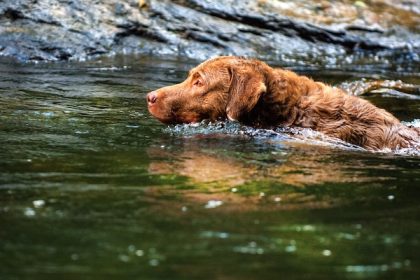
On Maryland’s Eastern Shore, a buck might buy you one oyster on the half shell—if you find the right special. But in the days when a silver dollar was money worth getting wet for, a wager between watermen could put a dog’s retrieving ability to an unusual test.
The object wasn’t a duck. It was the dollar itself.
As Richard A. Wolters recounts in Duck Dogs, watermen played a betting game in which a silver dollar was thrown overboard for their dogs to retrieve. The man who tossed in the coin gave his own dog the first chance to recover it. If the dog succeeded, it earned another turn with the next man’s dollar. The winning dog kept working until it failed.
A coin. On the bottom. Retrieved by a dog.
If that sounds like the sort of waterfront story that improves with every telling, Wolters apparently shared your skepticism. He considered it a tall tale—or, at best, a local legend—until he watched a dog accomplish the feat in eight feet of water.
The dogs behind this improbable pastime? Chesapeake Bay Retrievers.
That last detail makes the story a little less surprising. The Chesapeake wasn’t developed merely to enjoy a swim or bring back a bird under pleasant conditions. This was a working retriever expected to face wind, tide, long cold swims, and sometimes ice while recovering waterfowl along the bay. The American Chesapeake Club describes a breed built for repeated, strenuous retrieves under adverse conditions.
Nor was the job always finished when a dog reached the place where a bird had fallen. A wounded bird could move, evade capture, and turn a straightforward retrieve into a problem requiring persistence and independent judgment. Those qualities mattered to people who depended on their dogs to finish the work. The parent club specifically notes that Chesapeakes were expected to figure out problems, and identifies strength, intelligence, and perseverance among the breed’s working essentials.
The silver-dollar game puts those qualities in a different setting. Instead of recovering a bird, the dog was being asked to bring back something small, unfamiliar, and submerged. According to Wolters’s account, at least one Chesapeake was equal to the assignment.
There is a distinction worth keeping: his reported observation supports the feat he witnessed, not necessarily every detail of the game’s history. Without an earlier account, the tradition is best presented as a watermen’s story recorded by Wolters rather than a universally documented Eastern Shore pastime.
Still, it is a wonderfully fitting story for the breed. A Chesapeake’s reputation rests on work in difficult water, not on retrieving pocket change. But a dog coming up with a silver dollar does give “earning his keep” a rather literal meaning.
Photo by Marilou Burleson from Pixabay