
Long before texting took the place of person-to-person conversations, and long before “influencer” was an actual job, it took personal contact to share ideas and to network with other people.
Back in the day, in the early decades of the twentieth century, a “salon” was the place to see and be seen. The heart of intellectual and artistic life, these private social gatherings held at the home of a host or hostess provided an informal space for writers, painters, and political thinkers to debate, exchange ideas, and hoist the flag of their latest idea to see who might salute it. The salon concept, which often blurred the lines between social classes and genders, was quite radical for its time.
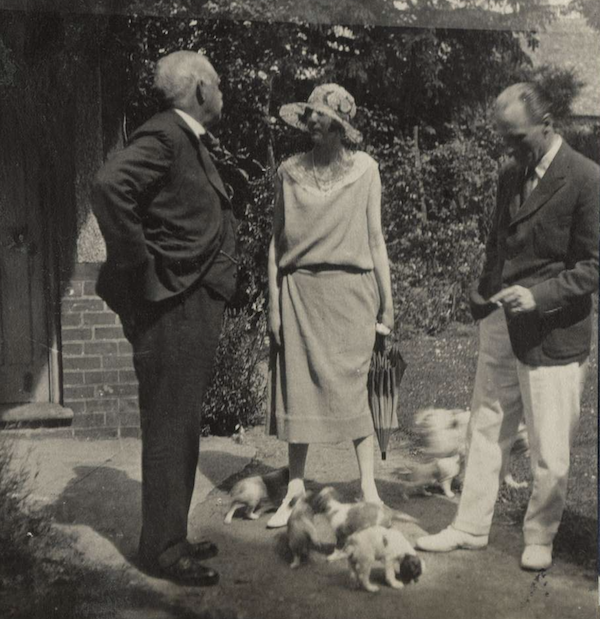
William Arthur Cavendish-Bentinck, 6th Duke of Portland; Rosamond Rose; unknown man, by Lady Ottoline Morrell. In public domain
It’s fair to say that successful salons could significantly enhance the social standing of their host. The reputation and influence of salonnières—women who hosted these gatherings—often extended well beyond their immediate social circles, allowing them to act as cultural power brokers and even patrons; one of the best at it in England was Lady Ottoline Morrell, a tall redhead with aquamarine eyes who used her exotically decorated home – and her merry band of Pugs – to offer refreshment and unguarded conversation rarely allowed elsewhere.
Today, we would call her an “influencer,” and Ottoline was seemingly born for the role. Her aristocratic roots saw her grow up privileged, and her marriage to Philip Morrell, a Liberal MP in 1902 only expanded her circle to include a who’s who of political and intellectual people. Between 1908 and 1928, her salon gatherings brought together the likes of Virginia Woolf, D.H. Lawrence, Aldous Huxley, Bertrand Russell, Augustus John, Henry Lamb, and members of the Bloomsbury Group. Reputations were made, scandals began, and cultural movements quietly took shape over food, drink, and what writer, Lytton Strachey described as a “surging mesh of pugs, peacocks, pianolas, and humans…”
Far from being hidden away to keep from being underfoot, the Pugs were often noted by visitors and biographers as being an important part of Ottoline’s salons. They trotted through rooms, accompanied guests, and contributed to an environment that was domestic, unconventional, and slightly theatrical all at once. In her 1992 biography, Ottoline Morrell: Life on the Grand Scale, author, Miranda Seymour, explicitly notes that the pugs “helped humanize the atmosphere” of her gatherings. We can’t take credit for the description we came across somewhere that described the Pugs as “social lubricants,” but it’s a marvelous visual.
Lady Ottoline Morrell’s most famous Pug was named Soie (French for “silk”), the only individual name of one of the Pugs we came across, and a simple internet search for images of “Lady Ottoline Morrell with her pug Soie” will bring up several photos. What became of Soie and Morrell’s other Pugs after her passing isn’t known to us, but it’s likely they were cared for by family or close friends.

Top image by © Irinayeryomina/Dreamstime