If only unwittingly, we tend to dismiss toy breeds as companion dogs with little purpose beyond a pint-sized cuddle machine. This is a mistake, and one need only look to the Italian Greyhound breed standard to prove it, and in particular, this line: Erect or button ears severely penalized.
Why?
Despite its delicate appearance, the breed was historically selected for speed, agility, and quick pursuit, and every element of its form—including the ears—supports that functional heritage.
Breed educators emphasize that Italian Greyhound ears are not merely cosmetic but are integral to the breed’s type and athletic function. At rest, a correctly shaped rose ear is thrown back and folded, closely hugging the skull to maintain the clean, refined outline called for in the standard. This natural carriage helps keep the head visually smooth, protects delicate ear leather from routine environmental wear, and preserves the characteristic sighthound expression. By contrast, button or erect ears project forward or upward, interrupting the wedge and rounding or “perking” the look of the head in a way that is foreign to true sighthound type. The ability of the rose ear to fold neatly and remain unobtrusive is thus central to both type and functional soundness, rather than a mere stylistic preference.
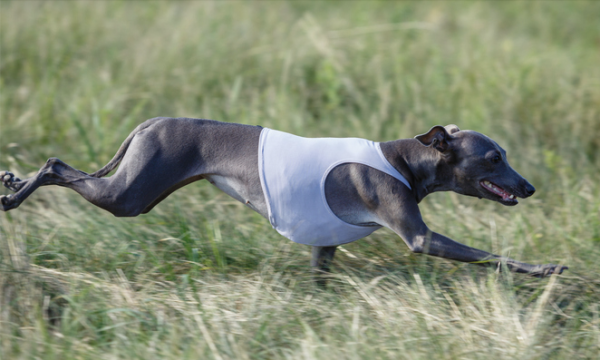
At a gallop, the Italian Greyhound’s entire silhouette tightens: neck, back, tail, and ears all work together to support an efficient, ground-covering stride. Correct rose ears lie close to the skull and disappear into the outline, allowing the head to move cleanly through the air and reducing the chance of the ear leather being buffeted or abraded. Erect or button ears upset this balance; they stand into the airstream instead of tucking away, can be thrown about more by movement and wind, and remain more exposed to contact with brush or debris. In a breed defined by refinement, speed, and effortless stride, even such “small” deviations in ear structure can meaningfully alter both the look and the way the dog goes.
When alert, the ears lift and fold at approximately right angles to the head, enhancing auditory perception and aiding precise sound localization without breaking the refined curves and wedge of the skull. Anatomically, the pinna is a highly mobile sound collector, controlled by numerous small muscles that allow subtle adjustments in position and angle. In sighthounds, this directional hearing works in tandem with exceptional visual tracking, supporting rapid response to subtle environmental cues. Italian Greyhounds retain this sensory coupling: ears that can briefly lift and pivot act as an early warning system, registering faint sounds or movement before the eyes fully engage. Button or erect ears do not eliminate hearing, but they can compromise the efficiency and directional focus of the pinna’s work in this breed, making its “radar dish” function less than ideal and the dog’s sound orientation less perfectly suited to the Italian Greyhound’s intended role.
Ear type also plays a crucial role in breed expression and type. The Italian Greyhound is a true miniature sighthound, and its wedge-shaped skull depends on properly folded rose ears to maintain the breed’s distinctive, refined expression. A structurally erect ear shifts the silhouette toward a different canine type, while button ears obscure the natural fold, producing a look more reminiscent of Terriers or Toy breeds than a miniature sighthound. Both deviations interfere with the visual and functional hallmarks that judges and breeders consider integral to the breed.
In short, the correct rose ear embodies a careful balance between athletic performance, aerodynamic efficiency, and sensory acuity. It allows momentary pricking for hearing while folding back seamlessly for speed, protection, and streamlined form. Erect and button ears disrupt this balance: they alter the refined wedge of the skull, distort expression, compromise the efficiency and directional focus of sound collection as envisioned for this breed, and undermine the aerodynamic profile essential to high-speed running. Because of this intimate linkage between ear structure, sensory function, expression, and performance, such deviations are treated as serious faults under the AKC standard (as well as the United Kennel Club). In fact, the FCI standard fleshes this out even more: Ears: Set very high, small, with fine cartilage, folded in itself and carried well back on the nape and upper part of the neck. When the dog is attentive, the base of the ear is erected and the lobe tends to stand out laterally on the horizontal, position commonly known as “flying ears” or “propeller ears”
Incorrect ears in this toy breed aren’t a minor cosmetic concern, they represent fundamental departures from both form and function, a reason they are severely penalized in a show ring.