Play along.
In a wine bar decorated with ferns and lots of candles, a woman tells her best girlfriend this about her husband: “He said he bruised his coccyx, but I think he just wanted someone to rub it.”
Later that week: Same wife to same BFF: “We did a little fartlek together — it got our hearts pounding! You’ve really got to winkle carefully if you want the best results.”
Gentle readers, we are still a family‑friendly, dog‑savvy site, and veteran readers know our fondness for obtuse routes to the real point. In this post, it’s ‘talk dirty to me.’”
In fact, while the syntax we used to make a few words sound suggestively “dirty,” every one of them is innocent. Coccyx, a name that comes from the Greek word “kokkux,” is an anatomical word for tailbone. Fartlek is a Swedish word that translates to “speed play” and is a type of training that combines periods of fast and slow running. And finally, the Middle English word, “winkle,” has been used for centuries to describe the action of getting something out.
It’s all in how one phrases a word, and if you haven’t guessed already, ‘dirty’ is the word of the post.
It might surprise some of you to learn that ‘dirty’ does appear in a few breed standards, but less of a surprise is that regardless of the registry, it almost always refers to color (we’ll mention the exception at the end).
As of this writing, the AKC has only one breed standard in which the word is used, and it belongs to the Great Dane:
Under Patterns/Markings: Brindle: Dirty colored Brindles are not desirable. Under Fawn: dirty colored Fawns; are not desirable. Under Harlequin: Eligible but less desirable, are black hairs showing through the white base coat which gives a salt and pepper or dirty appearance. The UKC standard includes much the same language.
The FCI also uses the word. In the Bernese Mountain Dog Standard under faults of colour and markings: “Dirty” white (strong spots of pigmentation). The UK Kennel Club’s standard for the Estrela Mountain Dog, also states that: “The fawn colour “should never be so pale as to be a dirty white.”
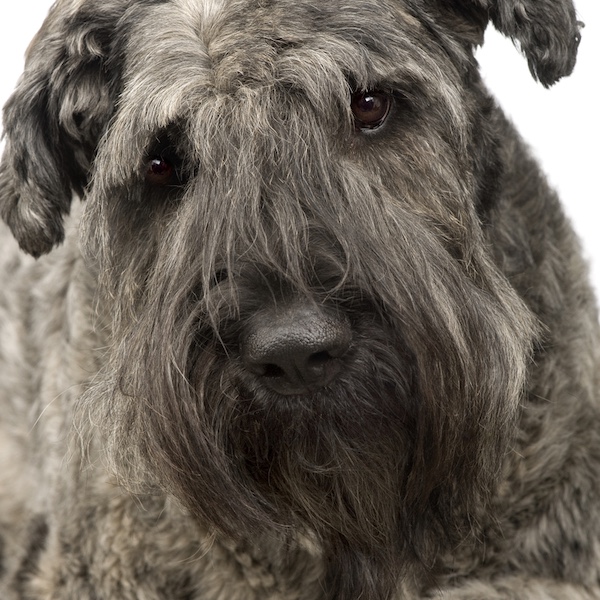
We promised to mention the exception to the observation that in breed standards, “dirty” almost always refers to color. The exception is an exceptional breed, the Bouvier des Flandres. Most serious fanciers know that an affectionate nickname for the breed is Vuilbaard or “dirty beard” but it appears only in the UKC General Description section standard of the United Kennel Club.
And there you have it: “dirty” isn’t really dirty at all. In the world of dogs, it usually just means a coat that’s a little off‑shade, a few black hairs where they shouldn’t be, or, in one special case, a breed nickname that breed owners smile. Whether you’re running fartleks, winking at a coccyx, or reading breed standards for fun, it’s all a reminder that context is everything—and that sometimes, the naughtiest word in a sentence can be completely innocent.
Image of a Bouvier des Flandres by Isselee/Dreamstime