The breed standard calls for a powerful, compact body with a square outline—height at the withers approximately equal to body length—and that geometry is anything but ornamental. A square frame concentrates muscle and mass in a way that promotes equilibrium and efficiency, allowing the dog to negotiate rocky slopes, dense forest, and uneven ground without wasting motion. This proportional balance supports endurance at all gaits, enabling long hours of tracking moose and other big game without early fatigue. Nothing is exaggerated, nothing is slack. The silhouette is a study in functional economy.
Substantial bone underpins that structure. The Elkhound is not coarse, but s/he is decidedly sturdy. A broad chest and deep body provide the internal capacity required for serious work—ample heart and lung room for sustained effort over miles of rough country. Depth of body, carried well back, enhances stamina, while muscular development through loin and thigh supplies the power for sudden bursts of speed or agile dodging when confronting formidable game. This is a dog built to accelerate, pivot, and hold ground when necessary, yet also to travel steadily for hours.
The feet complete the engineering. Comparatively small, tightly closed, and well-arched toes form compact units capable of absorbing concussion and maintaining traction. Thick pads, cushioned and durable, are protected further by hair between them—an adaptation that guards against cold, moisture, and abrasion. Whether crossing slick mountain rock, snow-packed trails, or wet forest floor, the Elkhound’s feet provide stability and resilience.
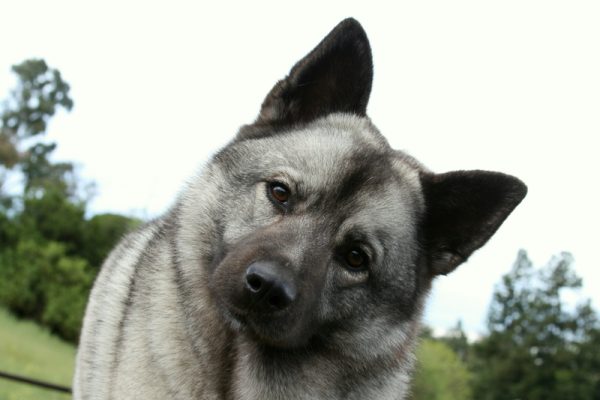
The headpiece is equally purposeful. A broad yet proportionate wedge-shaped head accommodates strong jaws and well-developed sensory apparatus without burdening the dog with excess weight. High-set, erect, and mobile ears act as finely tuned receivers, catching the faintest rustle of movement in woodland or the distant crack of a branch. Medium, dark eyes convey a frank and fearless expression, but more critically, they provide focused vision and wide awareness essential for tracking, vigilance, and silent communication with the hunter. The head is “dry” (without loose skin) because the latter would be functionally useless weight, apt to freeze, be prone to injury, and then infection. This clean, wedge-shaped outline reflects a hard, weatherproof working dog.
Perhaps no feature is more eloquently functional than the Elkhound’s double coat. A dense, woolly undercoat traps insulating air, preserving body heat in freezing conditions. Over it lies a coarse, straight outer coat whose guard hairs repel rain, snow, and brush, shielding the skin from moisture, wind, and thorns. The characteristic gray coloration, with black-tipped hairs, blends seamlessly into forested and rocky landscapes, offering natural camouflage. Together, these elements form protective armor that allows the dog to work long hours in rain, sleet, snow, and cold without retreat—an absolute necessity in its homeland.
The high, tightly curled tail is both practical and communicative. Carried firmly over the back, it remains clear of entanglement in thick undergrowth and visible to the hunter at a distance. Movement ties the entire design together: an even, effortless trot with a level back conserves energy and maximizes endurance, permitting deep forays into wilderness without structural breakdown.
The final expression of purpose just might be its temperament. Bold and energetic, the Elkhound was expected to track and hold large game at bay, barking persistently and maneuvering deftly until the hunter arrived. Such boldness wasn’t “showing off,” it was survival. As these dogs often worked beyond immediate human direction in rugged terrain, independence and persistence were vital.
Ultimately, the Norwegian Elkhound is the result of centuries of practical selection in harsh climates and demanding landscapes – a working solution made flesh.
Image by Sheryl Lynch/Dreamtimes