They make it look easy.
And if we humans had to do the same thing, we’d be dangling a two year old toddler from our jaws.
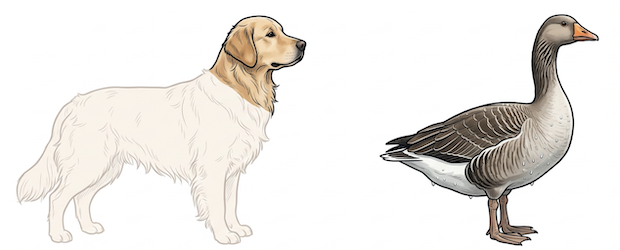
The Golden Retriever’s head is one of the hallmarks of the breed because it is critical to breed function. A strong muzzle and back-skull is crucial for carrying a game bird, including a goose that can weigh up to 13 pounds. This means that a Golden might carry 10–20 percent (or more) of its own body weight solely in its mouth when retrieving a big bird. In visual terms, it would look like the illustration below.
The small shaded portion of the Golden—the head and neck—that carries a much larger, heavier goose highlights how little of the dog’s body is actually supporting all that weight. That said, although the head and neck are the parts directly gripping and lifting the bird, they do not work in isolation; the rest of the front assembly and topline must be built correctly to support that load.
If we translate this to, say, a 150–175 pound adult human, we’d land in the ballpark of carrying 20–30 pounds only by our jaws.
How?
It’s not because of brute bite force alone, or even the mouth alone. Think of the classic children’s song “Dem Bones,” in which everything is connected. A Golden’s load is transmitted through cervical musculature, ligamentous support, scapular stabilization, and forelimb alignment. The head—broad through the backskull with a deep, wide, well‑filled muzzle—provides adequate oral capacity for carrying heavy game while preserving the breed’s essential soft mouth. A correct scissors bite with full dentition allows a secure, balanced hold without focal pressure that would damage the bird.
From there, the load is supported by a clean, moderately long, well‑muscled cervical column that transitions smoothly into properly angulated forequarters. Well laid‑back scapulae, ideally forming an approximate right angle with a humerus of equal length, position the forelimbs beneath the body at the withers, enabling efficient vertical load‑bearing through the thoracic limbs. This alignment allows the weight of the bird to be supported through the skeletal framework rather than suspended in front of it, as would occur in a straight, short upper‑arm assembly. The thoracic sling—comprising the surrounding musculature attaching the forelimb to the trunk—further stabilizes this load, while a firm, level topline maintains axial balance. In a correctly proportioned and angulated dog, these elements function cohesively to allow the Golden Retriever to carry substantial game with stability, efficiency, and minimal visible effort.
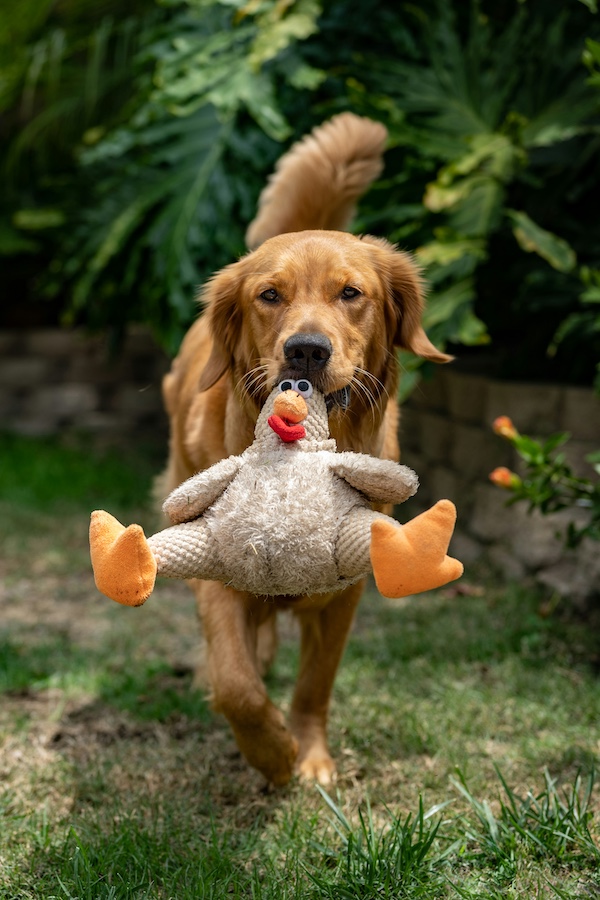
Image by Samantha Fortney (admittedly, the “bird in hand,” uh, mouth in the photo isn’t a goose, or even biological, but the beloved chicken toy worked for us.)