
There are often things that puzzle us while reading about breeds, and one of them is the way some people imagine dogs of the past. At the risk of veering a bit off our intended topic, we refer to one or two blogs that resurface every few years. In these pieces, the authors present photos of different dog breeds from around 100 years ago to emphasize their belief that various breeds have been ‘ruined’ because today’s versions look radically different from those of the past. Preservation breeders and fanciers of those breeds are the best judges of that assertion for their respective breeds, but when *we* look at those historical photos, what we most notice are sagging toplines, broken pasterns, cow hocks, and poor angulation—features that suggest these dogs probably didn’t have many days without pain.
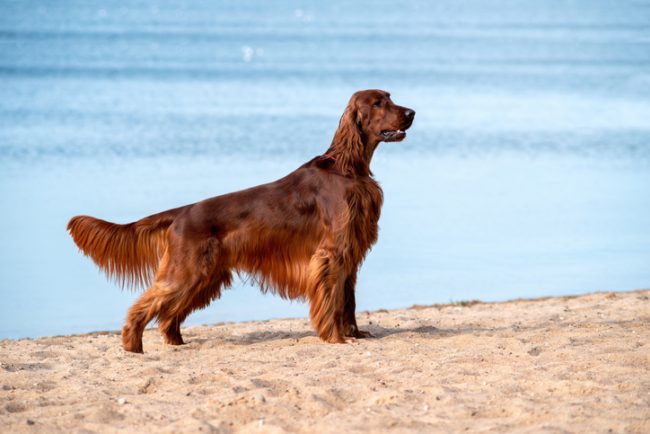
More to the point of this post is the perception within various breeds that over the years, dogs have gotten bigger/smaller/heavier/finer (pick one) when available information doesn’t support that perception. We use the fabulous Irish Setter as an example because over the course of the 40 years we have been in the fancy, we occasionally heard that today’s Irish Setter is considerably finer and smaller than those of 100+years ago.
But is that really true?
In 1879, Hugh Dalziel, a British author and canine authority known for his influential book, “British Dogs: Their Varieties, History, Characteristics, Breeding, Management and Exhibition,” wrote extensively about the history, standards, and characteristics of various dog breeds. He provided detailed descriptions and guidance to breeders, fanciers, and exhibitors of his era, and it was Dalziel who stated that Irish Setters stood 24 inches tall and weighed 55 pounds in his time. Today’s AKC breed standard, however, writes that 27 inches at the withers and a show weight of about 70 pounds is considered ideal for a dog (for a bitch, 25 inches and 60 pounds) and variances beyond an inch up or down are discouraged. In reality, the breed has become both significantly taller and heavier over the past century, not smaller.
What’s up with that?
We would be guessing as to why such a misconception might exist, and we’d have to start with the photographs, themselves. Early photographs made dogs appear more robust or larger than they actually were because early cameras typically used lenses with a narrow field of view that could exaggerate the size of subjects in the foreground. Head and chest portraits in particular minimized the background and without environmental scale cues, such as a person, we have no reliable way to judge the dog’s actual size; this makes it easy to perceive the dog as being larger. Some photographic processes, like early daguerreotypes or tintypes, could also cause slight distortions or flattening that contributed to the impression of greater size.
And then there is the influence of popular culture. Could the Disney movie,’Big Red,’ have skewed collective memory towards recalling larger dogs than the documented historical average?
We have no definitive answer as to why there was the persistent myth that Irish Setters were once much larger than they are today—even though current breed averages are demonstrably higher in both height and weight. Mind you – and this is important – this isn’t to say that some dogs and some lines aren’t smaller, but we are looking at breed standards to set the ideal.
If nothing else, it’s a topic for a lively discussion in any breed at, say, a National Specialty or at dinner after the dog show.
Image of Irish Setter by Volha Maksimava/iStock