
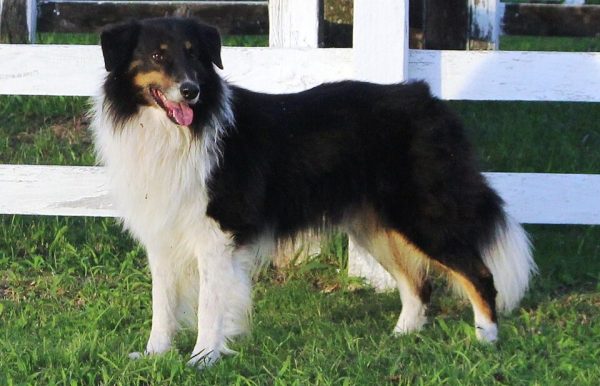
Imagine being a ranch worker and having your employability based on the strength of your dog.
In some parts of Rio Grande do Sul, the southernmost state of Brazil, this is what faced peões (ranch workers) seeking work. Nor could an estancieiro (the owner of an “estância,” a large rural estate or ranch raising cattle or sheep) be faulted for this selectivity. Entrusting valuable herds to a worker in the demanding and unpredictable terrain of the Pampas meant staking the ranch’s prosperity on the proven ability of both the worker and his dogs; only the best could be counted on to meet rigorous challenges of the pampas, a grassland notorious for a sudden change in topography following a heavy rain or drought. Frequent temperature shifts, flooding, and dry spells called for herding dogs that could cover long distances across unstable terrain, stay alert for stragglers, and work in intense heat, biting cold, or driving rain. The dogs had to be able to adapt to periods of scarcity, shifting pastures, and the stress of constant environmental change, all while maintaining focus and calmness to manage large herds efficiently.
Only one breed proved itself up to the challenge, and this was the Ovelheiro Gaúcho.
Also known as the Gaucho Sheepdog, ranch workers were often hired on the strength of his Ovelheiro dogs — showing just how economically important these dogs were. In fact, on September 22, 2020, a law declaring the Ovelheiro Gaúcho as a symbolic animal of Rio Grande do Sul was enacted by the state government of Rio Grande do Sul, specifically passed by the Legislative Assembly of Rio Grande do Sul and sanctioned by the state governor at the time, Eduardo Leite. It officially recognized the Gaucho Sheepdog as part of the state’s cultural and genetic heritage.
In its early days, the Ovelheiro Gaúcho was valued solely as a working herding dog molded by gauchos who prioritized traits like working ability, intelligence, stamina, and adaptability over appearance or pedigree. It’s possible that a mix of local working dogs in Rio Grande do Sul were crossed — theoretically — with Old Scotch Collies, Rough Collies, the Portuguese Serra‑da‑Estrela Dog, and possibly German Shepherds. According to the breed’s own association, these hypotheses derive from analyses of physical traits, behavior, and historical context. One theory proposes that the “ancient Collie type” brought by European settlers contributed to the Ovelheiro’s herding instinct, coat colors, ear shapes, and facial structure. Another hypothesis, based on morphological studies, suggests that German Shepherds were added to increase “alarm‑dog” qualities such as barking and guarding, while the Serra‑da‑Estrela may have lent robustness and structure. A genetic‑composition analysis even showed significant markers for Old Scotch Collie, Rough Collie, and Shetland Sheepdog in sampled Ovelheiro Gaúcho dogs.
It should be noted that these theories remain debated among breeders, and there is no absolute consensus on which breeds contributed most genetically. Modern breed authorities continue to investigate the Ovelheiro’s origin. But in 2020, the breed was officially recognized as a cultural and genetic heritage of Rio Grande do Sul, and today it is registered as a purebred by the Confederação Brasileira de Cinofilia (CBKC), with clear standards for size, coat, color, head shape, and temperament, while still retaining its original working abilities.
According to data from a breeders’ community, there are over 14,000 Ovelheiro Gaúcho dogs registered with Brazil’s official national kennel club, the Confederação Brasileira de Cinofilia (CBKC). While international exposure remains limited, the breed marked a milestone in visibility at the 2022 World Dog Show Brazil, where roughly 20 Ovelheiro Gaúcho dogs were entered. Outside Brazil, the breed is still rare, though an increasing number are being kept as family pets in urban areas due to their adaptability and temperament.
In 2023, dedicated breeders, along with the CBKC, began the process of seeking FCI recognition for the breed. They did a detailed revision of the breed standard, translated and refined it in collaboration with the Departamento do Ovelheiro Gaúcho and other national breed authorities, then submitted the updated standard to the FCI’s technical council in Belgium. To our knowledge, the breed is currently listed in Group 11 of the CBKC which includes Brazilian breeds not yet recognized by the FCI.
Photo of a Ovelheiro Gaúcho by Diegopaz070588