Behold a specialized scent-delivery system wrapped in soft tissue, hair, loyalty, and love. You know this air-and-ground scenting pointing dog as the Bracco Italiano, but after we examine a very small portion of its AKC breed standard, it may become apparent why the breed could be nicknamed the “Professor of Perception,” the dog that seems to think through its nose.
Everything from the atlas bone* forward in the Bracco Italiano is engineered for high-fidelity data processing. A “methodical” hunter, the Bracco needs constant, uninterrupted sensory input to do its job. In this post, we focus on a mere six lines from the standard that help the dog do just that. The six lines:
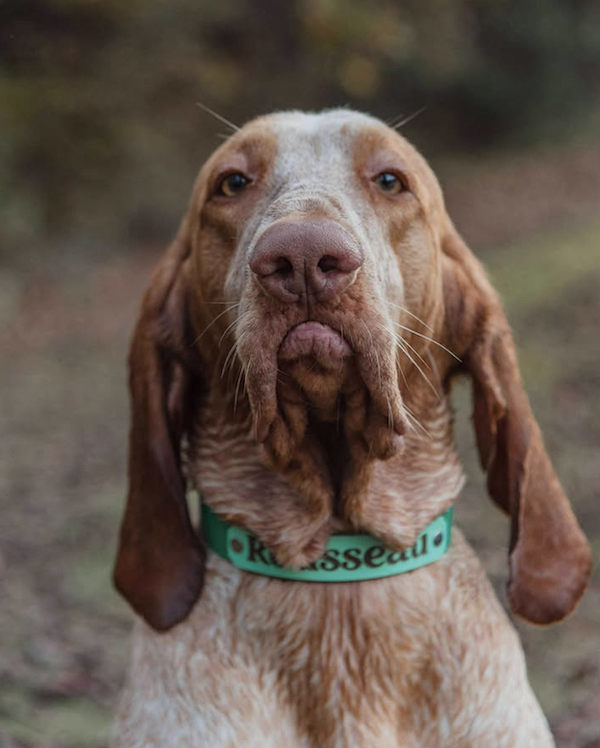
The chin is not very apparent. Nose – Voluminous, with large well-opened nostrils, protrudes slightly over the lips with which it forms an angle. Color brown or from pale pink to more or less deep fleshy red depending on the color of the coat. A split nose is a disqualification. Lips – Upper lips well developed, thin and floppy without being flaccid, covering the jaw; seen in profile, they overlap the lower jaw slightly**;** seen from the front, they form an inverted “V” below the nose; the corner of the lips must be marked without being droopy.
Let’s take this in order.
The chin. It’s actually an interesting place to start because a chin doesn’t seem like it would have much bearing on a dog’s hunting ability.
Au contraire!
In the Bracco Italiano, the chin is purposely kept subtle. This reflects the way the skull and muzzle diverge, creating the breed’s trademark down-faced, Roman-nosed look with a long, clean, slightly tapered muzzle. A projecting chin would change how the front of the muzzle is presented, of course, but the Bracco’s receding chin allows the nose and upper lip to lead—visually and functionally—drawing attention to the nasal planum and wide nostrils where scent is actually taken in.
This cleaner front profile complements the breed’s high, elastic head carriage at the trot. It supports a style in which the dog’s nose is naturally oriented to sample both air currents and scent rising from the ground, even though head height is governed by overall structure, musculature, and training, not the chin alone.
We pause here for a brief lesson in Bracco terminology: a filata is the breed’s characteristic way of coming onto point. Instead of slamming to a halt, the dog detects scent and then “threads,” or glides, into it with a series of increasingly slow, deliberate steps. During the *filata*, the head and neck make small adjustments while the muzzle gradually lowers to refine the scent cone, and the whole dog seems to flow forward until it finally hardens into a motionless point.
This matters because, during the characteristic filata, the dog can lower its muzzle and refine the scent cone while remaining balanced and composed, a coordinated behavior made easier by a head that is long, substantial enough to be stable, but not front-loaded by a prominent undershot jaw or chin. At the same time, the deep muzzle provides generous space for wide nasal passages and a capacious oral cavity, allowing effective panting for heat loss in Mediterranean conditions while the nasal cavity continues its primary work of olfaction—two systems that must operate side by side in a dog expected to hunt methodically all day.
And here we come to the nose. “Nose – Voluminous, with large well-opened nostrils…” is no throwaway line; it describes the Bracco’s primary working tool. A large, roomy nose generally corresponds to greater internal surface area for olfactory epithelium, while wide, mobile nostrils increase air intake with each breath and can flare to capture faint, shifting odors. Together, these features allow the dog to take in more odor per inhalation and to sort out complex, layered scent cones in real field conditions where wind and cover scramble the picture.
Recall that when the standard calls for the nose to “protrude slightly over the lips with which it forms an angle,” it is describing a forward-positioned intake set just ahead of the surrounding soft tissue. That slight projection helps present the nostrils cleanly into the airstream, so when the Bracco is driving into the wind or following low scent, it can efficiently sample both air and ground odor without losing information.
Amazing, eh?
In case you think you have a “gotcha” moment in assuming color has nothing to do with the dog’s hunting ability—you don’t. Pigment that harmonizes with coat color helps protect the nasal planum from sun and environmental irritation during long days in open country, while still reflecting the dilute and roan color genetics typical of the breed. The described range also aligns with well-vascularized, moist nasal tissue, important because a healthy nose must remain moist to dissolve odorant molecules—essential for olfactory reception.
And finally, the lips. The Bracco’s upper lips are classic continental pointer equipment, but finely tuned for an all-day, trotting gun dog. Well developed yet relatively thin and not overly flaccid, they hang as a soft curtain over the lower jaw, increasing the moist surface around the mouth and helping retain scent-laden air in the vicinity of the nostrils as the dog moves through cover.
Seen from the front, they form the breed’s hallmark inverted “V,” which may help channel airflow toward the nostrils rather than allowing it to dissipate laterally. In profile, the slight overlap contributes to a clean outline and helps protect the lower lip. Marked but not droopy corners give enough structure for the lips to stay neat at the trot, minimize drooling and debris pockets, and allow the dog to breathe efficiently and carry birds with a soft, secure grip.
Taken together, these are not just “jowls,” but a carefully balanced lip system that supports scent acquisition, protects the mouth, and complements the Bracco’s steady, methodical hunting style.
From the atlas forward, every curve and contour serves the same end: to let this “Professor of Perception” read the invisible world on the wind and in the cover, and translate it into birds on the wing for the person walking behind.
*If you place your hand at the back of the skull where the bony occipital “ridge” ends and then slide just a fraction of an inch down the neck, you are essentially over the atlas bone.
Photo of Rousseau, a most excellent Bracco Italiano/photo credit to Kailee Hale Joyner