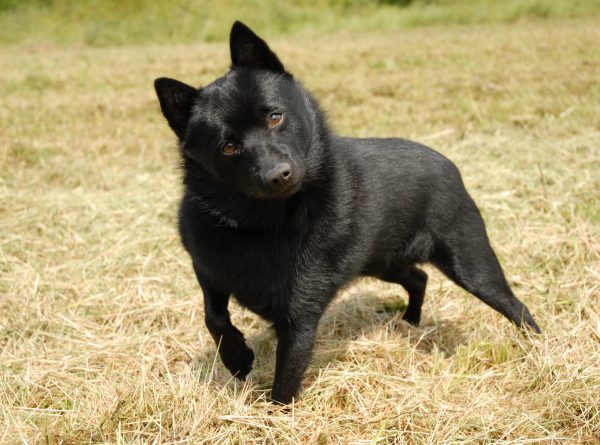
What does the person in the photo below have in common with the Schipperke?
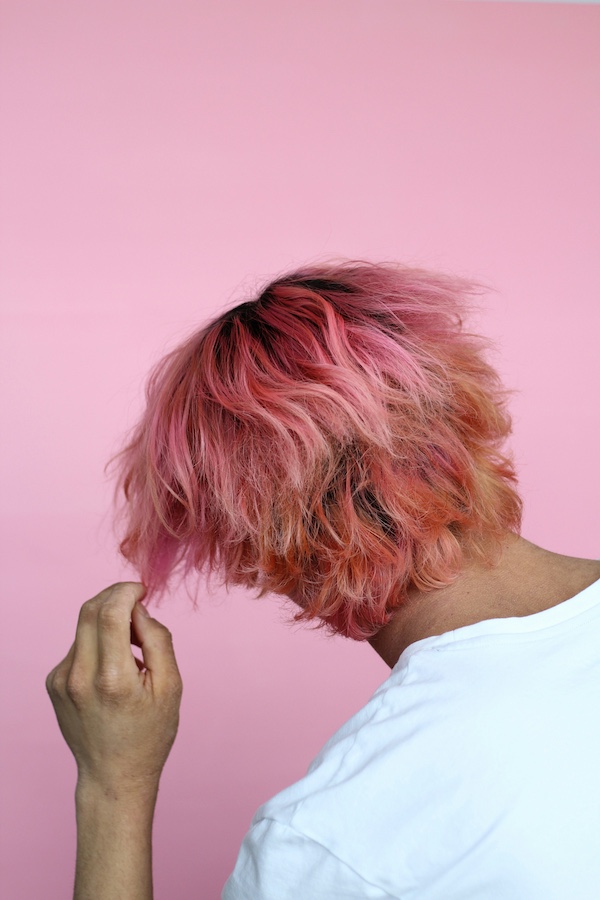
Photo by Rosalye Simard
You’ve probably guessed that it might have something to do with HAIR, and you’d be right. But what?
Hint: It has to do with different hair lengths! Both this human and the breed have hair of varying lengths.
One day, the chap in the photo might cringe at his younger self’s pink hair (or not), but one of the Schipperke defining characteristics is a unique silhouette, and it is shaped by the coat’s varying hair lengths.
According to the AKC, the hair is short on the face, ears, front of the forelegs, and hocks, medium-length on the body, and longer hair forms the “ruff” around the neck, the “cape” over the shoulders, the “jabot” down the chest, and “culottes” on the rear thighs. Without this “recipe,” the breed’s characteristic outline is lost, and the old Belgium standard, and standards from the AKC, FCI, and The Kennel Club are in agreement on this. The breed is described as small, square, cobby, and thickset, with a foxlike expression, and the correct coat pattern is considered essential to this look. Any deviation from the ideal coat pattern or silhouette should be penalized to the extent of the deviation.
And how much “wiggle room” is there for deviation?
Not a lot. A lack of distinction between the coat sections should be penalized, as should improper proportions of hair length. Hair growth pattern is even specific. Down the middle of the breed’s back—starting behind the cape and continuing over the rump—the hair lies flat. This pattern should be apparent even in puppies or when a Schippie is out of coat.
We like to think we’ve made lighthearted case for the Schipperke having layered hair in common with the pink haired punkster, but for readers who believe the Schipperke can be any color as long as it’s black, news flash: the breed does come in other colors! From platinum to strawberry shades to shades of light mocha to dark chocolate, blonde and brown Schipperkes are accepted and recognized by the United Kennel Club. Similarly, The Kennel Club in England permits Schipperkes in colors other than black, including cream, fawn, and gold tones.. We fancy that if one only ever saw Schipperkes at dog shows held by the AKC, FCI countries, or the Canadian Kennel Club (which all require Schipperkes to be solid black), any other color dog would look like a “punk Schipperke.”
Can’t picture a blonde Schipperke? Here you go (and one more)! And here’s brown.


