When it comes to canine structure, many of the terms we share with you on these pages are veterinary anatomical terms, but most are not; these are colloquial terms used by breeders and fanciers that often work their way into the “culture.” We’ve used terms like ‘clean, dry, or wet’ (necks), ‘shangles’ (a doggie dispute), ‘Fiddle, Cabriole, Chippendale, & French’ (fronts), and so many more as they apply to specific breeds (the Coonhound world should have a dictionary all its own!).
If we’re lucky, we might come across such terms in breed standards, and if we’re really lucky, the term is unique and breed specific, and not in English (more on that in a bit).
Here we pivot to the beloved Saint Bernard. Early AKC breed standards were adapted from original Swiss standards when the breed was imported and recognized in the United States. Early American breeders and fanciers used translated or bilingual versions of these continental standards, and kept important anatomical or descriptive terms in order to be accurate, consistent with the breed’s Swiss roots, and to honor the Saint Bernard’s heritage. One of the terms was “burr.”
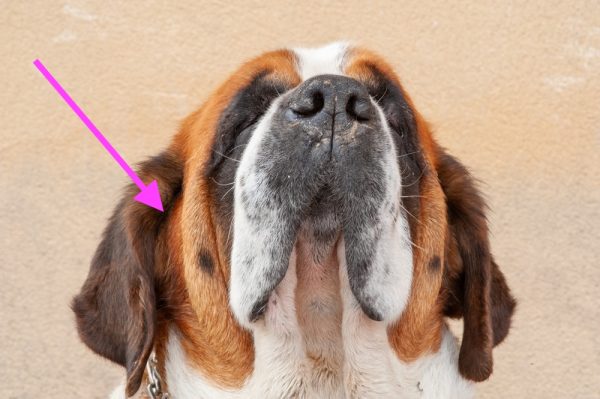
The term, “burr” is not unique to the Saint Bernard since it also appears in the standard of the Bulldog, but in the Saint’s standard is another word, and it is decidedly unique to the breed. Spot it in the sentence from the standard: “Ears – Of medium size, rather high set, with very strongly developed burr (Muschel) at the base.”
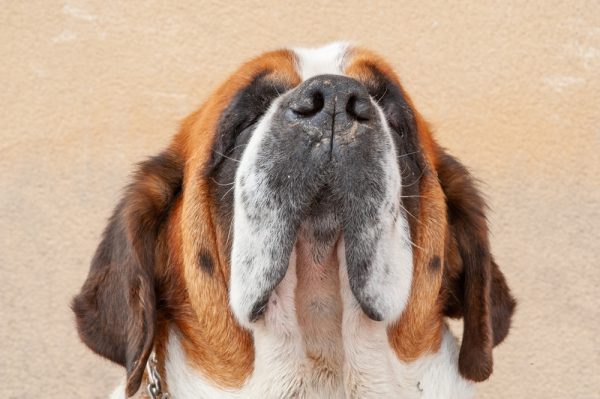
The German word, “Muschel” is often paired with “burr” as a synonym, and both were retained to maintain accuracy in describing breed-typical features. Translated into English, “muschel” means “shell,” and in the context of conformation, it refers to the thick, padded region of the Saint Bernard’s ear where it attaches to the head. This spot is a breed-defining trait because it creates a pronounced, slightly raised area at the ear base which helps visibly define the head shape, and thus, breed type. It contributes to the correct outline of the Saint Bernard’s head when viewed in profile or from the front because it accentuates the breadth and squareness of the skull.
The Muschel isn’t just a technical term; it’s a breed-defining hallmark that connects today’s Saint Bernards with their Swiss heritage. It’s one more reason we celebrate the heritage of purebred dogs.
Image from Shutterstock by solosacofotos