We have long been fans of breed standards that contain colorful language. Vivid terms make it easier to remember aspects of a breed, and the dog world has certainly produced its share of memorable imagery. Where else might one encounter spectacles, breeches, dead grass, hare feet, otter tails, and noses compared with everything from Roman architecture to—apparently—produce?
The Spinone Italiano now contributes a mushroom.
In a published report on her Spinone Club of America National Specialty assignment, judge Meghen Riese-Bassel noted the quality of expression and the large, distinctive noses she found throughout the entry. She used the memorable phrase “mushroom” nose, and later described the nose of one of her winners as “big and fleshy,” observing that it contributed to true Spinone expression. Her remarks provide a helpful starting point for looking more closely at one of the breed’s most recognizable features, and we cannot resist fleshing it out. Pun intended.
A point of accuracy comes first: “mushroom nose” is colorful shorthand, not official breed-standard terminology. You will not find the expression in the AKC Standard, but it is an effective visual description—and the Standard itself does a fine job of explaining why.
The AKC Standard says the Spinone’s nose is “large, bulbous and spongy in appearance with a rounded upper edge.” Its nostrils are to be large and well opened, while the nose, seen in profile, protrudes past the forward line of the lips. Pigment is rosy flesh-colored in white-and-orange dogs, brown in brown-and-white or brown-roan dogs, and may range from flesh-colored to brown in solid-white dogs.
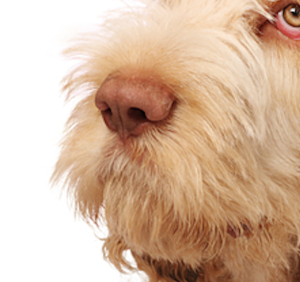
Detail from ©Tracy Hebden’s larger photo /Dreamstime
That said, we can see why Judge Riese-Bassel used the mushroom comparison. The broad, bulbous, conspicuously rounded upper portion of this wonderful breed’s nose rather does suggest a mushroom cap. You can see it, right?
The Italian breed description carried by the Fédération Cynologique Internationale is even more emphatic. It calls for a nose that is “voluminous” and “spongy in appearance,” with a “very thick and distinctly rounded upper edge.” The nostrils are described as large and protruding, and the nose is to extend beyond the vertical line of the lips. The Royal Kennel Club standard makes the same general point, requiring a large, spongy-looking nose with large nostrils.
The Spinone Club of America’s educational material completes the picture. Its judges’ education page describes a large, spongy nose with wide-open nostrils, while reminding judges that the Spinone is unlike other Sporting breeds and must be understood as a complete, functional hunting dog.
This is not an ornamental “honk-here” button attached to a shaggy face. It is an exaggerated-looking but purposeful piece of scenting equipment—and part of an expression so characteristic that the AKC Standard describes the Spinone as having a soft, almost-human expression. A conspicuously large nose and wide-open nostrils suit a dog expected to work scent steadily and efficiently.
The next time someone refers to a Spinone’s mushroom nose, picture more than a comical fungus planted on the end of the muzzle. The colorful shorthand captures an entire cluster of breed characteristics: size, breadth, projection, open nostrils, and that unmistakably thick, rounded upper edge.
It may not be official terminology—but, as breed descriptions go, it has certainly mushroomed on us.
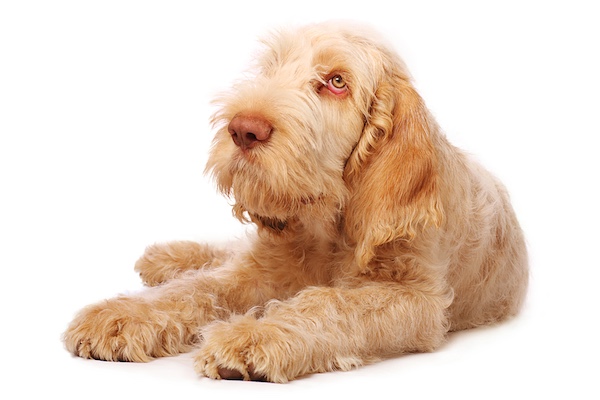
Image: Spinone Italiano © Tracy Hebden / Dreamstime