“Spaniel brain.” This was a new one for us.
Encountered in a breed forum, the term is not entirely inappropriate given the Papillon’s superb athleticism, but still…….a spaniel?
Historically, that’s not inaccurate either. According to the Papillon Club of America, the Papillon’s “spaniel” designation has nothing to do with flushing game and instead reflects historical classification practices. The term spaniel, meaning “dog of Spain,” was applied broadly to a family of dogs that shared common type and lineage rather than a single function or origin. The small toy spaniels depicted in Renaissance art—ancestors of the Papillon—were considered part of this wider spaniel family based on their physical characteristics and heritage, even though they were bred primarily as companion and court dogs. In that sense, the “spaniel” label persisted as a traditional group name carried forward from earlier classifications, rather than indicating a working role or a strictly Spanish origin. It is reflected in other early names for the Papillon, including the Continental Toy Spaniel, Titian Spaniel, Royal Toy Spaniel, and Dwarf Spaniel.
Given that the Papillon is not a true spaniel, that made the next linguistic ‘find’ equally surprising: Squirrel Spaniel. If the Papillon is a “spaniel” only by inherited name rather than by function, how is one to understand the even more vivid nickname, “Squirrel Spaniel?”
Unlike the casual use of “spaniel brain” in an affectionate nod to the breed, “Squirrel Spaniel” appears in several more formal settings. In 1915, the same year the AKC recognized the Papillon, Walter Esplin Mason used the term in his book, Dogs of All Nations. A few years later in 1921, Dr. William A. Bruette, a prominent judge and editor of Forest and Stream noted in his Complete Dog Book that the name, “Squirrel Spaniel” was sometimes applied to the breed. In addition to others using the term including Robert Leighton and G.O. Shields, the squirrel reference appears in the AKC’s Pure-bred Dogs published in 1929.
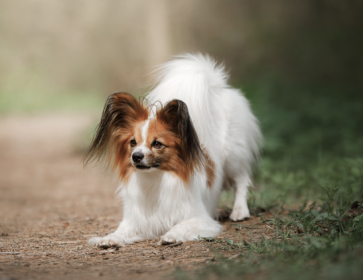
By the time the breed captivated a wider circle, its endearing ears had almost entirely superseded the “squirrel” nickname in official show circles, but it will surprise no one that the bushy feature at the opposite end of the ears accounted for the nickname. Squirrel Spaniel referred not to a role, but to a lushly plumed tail. From the aforementioned AKC book: Tail: Long, very well fringed, forming a handsome plume, carried like the tails of a squirrel with the end lying on the back.”
It’s a little thing, but there is no detail too small to the person keen to learn all there is about their breed.
Image ©Annaav/Dreamstime