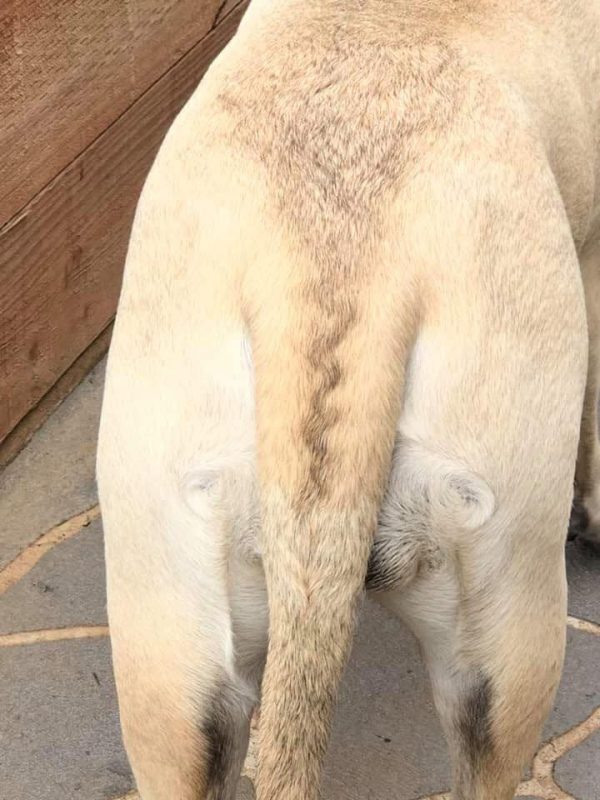
If you look closely at the tail of some fawn Bullmastiffs, you might find a jagged, dark zig-zag—a ghostly thumbprint left behind by the shadows of a 19th-century English forest that served as a tactical weapon of camouflage.
While not codified in the official AKC breed standard, some long-time fanciers point to the “chevron” marking on the tail as a visible echo of the breed’s working heritage.
Some breeder-writers even describe this subtle yet distinctive feature as a reminder of the Bullmastiff’s foundational development, which famously paired the Old English Mastiff with the Old English Bulldog in a commonly cited approximate 60/40 ratio to create the “Gamekeeper’s Night Dog” of Victorian England.
As English gamekeepers were refining the Bullmastiff in the mid-19th century, their priority was effectiveness. In the high stakes of patrolling darkened estates, any dog that stood out too clearly in moonlight risked detection, granting a poacher the opportunity to flee or, more dangerously, prepare an ambush for the dog and its handler. A coat that broke up outline and absorbed shadow offered a practical advantage, allowing the dog to blend into the dappled woodland and close the distance before the intruder even realized a dog was there.
However, as the Bullmastiff transitioned from forest guardian to family protector and show dog, fawns and reds became especially fashionable, and these solid colors gained significant popularity. This shift in emphasis is what makes the tail chevron so interesting to cynologists; on an otherwise clear fawn or red coat, that darker zig-zag appears almost like a lingering trace of the breed’s rugged past.
To be strictly accurate, modern coat-color genetics clarifies that the darker dorsal shading sometimes seen on the tail of a fawn or red Bullmastiff is best explained as normal sable (agouti) expression. Typically associated with the Ay allele at the ASIP locus, this pattern commonly produces concentrated eumelanin along the topline and tail. In other words, the chevron on a clear fawn is not evidence of a separate color pattern, but a natural variation in pigment distribution. There is no documented, breed-specific “chevron gene”; the marking is best understood as localized shading influenced by how pigment is laid down along the back and tail.
Classical references like Clarence C. Little’s The Inheritance of Coat Colour in Dogs underline the complexity of coat-color inheritance and the way multiple loci interact to produce variations in pigment intensity and distribution. While strong pigment is associated with depth of color and a solid black mask, the tail chevron itself is simply a cosmetic expression of normal coat variation rather than a discrete inherited trait. Viewed through that lens, residual patterning — like the darker dorsal chevron on an otherwise solid dog — can be appreciated as an example of how pigment concentrates along the topline in some individuals.
The term “chevron” itself appears primarily in specialized breed literature and judging education materials rather than in the official standard. Authoritative evaluation resources such as Showsight Magazine use the term descriptively when referring to V-shaped or zigzag patterning across a coat, though this usage does not specifically address tail markings in fawn dogs.
Canine historians like David Hancock emphasize strong pigment and traditional coloration as hallmarks of the old-type Mastiff family dog. The reason the chevron is omitted from the formal AKC standard has less to do with its significance and more to do with the standard’s focus: defining the essential silhouette, color, and temperament of the Bullmastiff rather than cataloging every subtle, non-functional nuance of hair direction or localized shading. Because the tail chevron is a cosmetic whisper of pigment rather than a structural necessity, it is left out of official standards, leaving ample room for a wide range of high-quality dogs. Nevertheless, for the dedicated student of the breed, its presence remains a charming visual link to the Bullmastiff’s storied past as the silent guardian of the English estates.
Our sincere thanks to Emma McFawn for sharing a photo of her Bullmastiff with the chevron on their tail