
Most modern governments treat their top leaders the way airlines treat data backups: you never put everything that matters on a single flight. In many parliamentary systems (Germany, Canada, Australia, etc.), it is standard security practice not to put the head of government and the next key successor together on the same state aircraft. The U.S. president and vice president don’t typically fly together, nor do the UK’s monarch and the prime minister normally share a plane.
Centuries before there were jets, motorcades, or even the phrase “continuity of government,” a Scottish king is said to have applied that same instinct to something far smaller and furrier: his terriers.
It is one of the most enduring stories in terrier history. About four centuries ago, King James VI of Scotland is said to have sent several prized Scottish “Earth Dogges” as a royal gift to the French court. The little rough-coated hunting terriers were considered so valuable that they were distributed among separate ships crossing the Channel, so that if one vessel foundered in a storm, the entire canine cargo would not be lost.
It’s a wonderful story, but is it true? We like to think so. While no contemporary documentation has yet been found, the story appears consistently in terrier histories dating back many generations.
No surviving shipping manifest has surfaced listing the dogs by name, type, or vessel. Nor has anyone uncovered a royal order that reads, “Put the terriers on different ships.” What we have instead is a remarkably persistent tradition repeated across generations of Scottish terrier and Cairn-type histories. The sheer consistency of the story is one reason careful writers have been reluctant to dismiss it outright.
What is less disputed is that James VI had both the opportunity and the motivation to send such a gift. The Scottish king maintained diplomatic contact with the French court and was no stranger to the use of prestigious animals as political currency. In the late sixteenth and early seventeenth centuries, unusual hunting dogs, horses, falcons, and other creatures functioned as living symbols of wealth, status, and national pride.
It should be noted that the dogs in question were not Scottish Terriers, Cairn Terriers, or West Highland White Terriers as we know them today. It would be centuries before the dogs were identified as unique breeds. They were simply Scottish “earth dogges,” hardy little vermin hunters developed to pursue foxes, badgers, otters, and other quarry into rocky dens and cairns.
Who got the dogs?
The story gets murkier here. Many modern accounts simply state that the dogs were sent to “the King of France,” and we know that during the period in question, the French throne was occupied by Henry IV, the first Bourbon king. It’s plausible that he was the intended recipient. Other writers, however, suggest the dogs may have been presented to members of the French royal circle rather than directly to Henry himself. To the frustration of terrier breed historians, no contemporary document yet discovered settles the matter.
What the story does show is how highly these little working terriers were regarded. Long before kennel clubs, dog shows, pedigrees, or breed standards, Scottish earth dogs had earned a reputation valuable enough to travel as diplomatic gifts between royal courts.
And four centuries later, terriers are still showing they are worthy shipmates — sometimes as the sole survivor.
In 2025, James “Jemsie” Nunan, a 34-year-old British sailor, set out on a solo round-the-world voyage with his 18-month-old Jack Russell Terrier, Thumbelina, as his only crew. In late August he was last confirmed on land at Las Palmas, Gran Canaria, before putting back to sea. When he failed to make expected contact, a search began. About a week later, his yacht was discovered drifting far off the southern coast of Gran Canaria with no sign of Jemsie on board. There was just one living soul aboard — Thumbelina. She was alive and in surprisingly good condition, waiting in the only home she knew.
It isn’t known how Nunan and his boat parted company. Investigators have yet to determine how he disappeared, but solo sailors know too well how quickly a misstep on a wet deck, an unanticipated lurch of the boat, or a loose line snagged at the wrong instant can pitch a person into the sea. What is known is that sometime after leaving Las Palmas, the sailor was gone, but the yacht — and Thumbelina — carried on.
As of this writing, Nunan has not been declared dead; he remains officially listed as a missing person. Thumbelina was rescued from the drifting yacht and taken first to a shelter on Gran Canaria. She was later brought back to the United Kingdom and into the care of people connected to her lost sailor.
These two tales could not be more different: one story is wrapped in royal correspondence and legend, the other in modern missing-person reports — but we hold fast to the common thread of a terrier at sea.
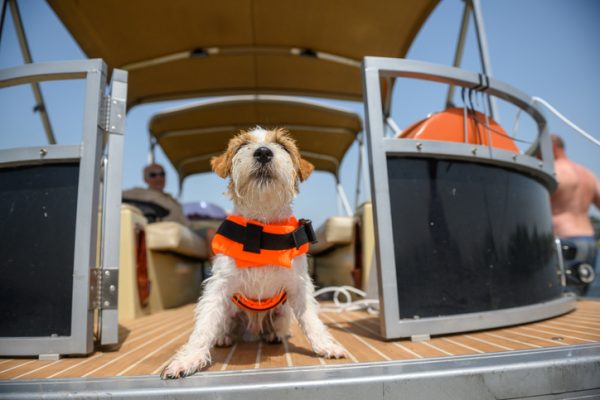
Photo of a Jack Russell Terrier on a yacht by Andrii Gorb/iStock