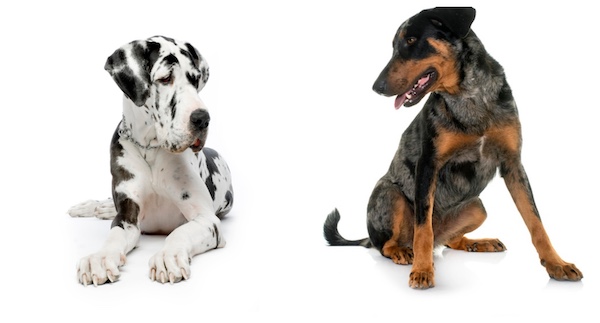
Harlequin to a Great Dane person does not mean the same thing as it does to a Beauceron owner. To the Dane owner, the word evokes the image of a white dog splashed with torn black patches. A black-and-tan dog patterned with blue-gray mottling, however, is what the Beauceron owner sees in their mind’s eye. Same word, different breed, different standard, different visual effect.
How did this happen?
The short answer is that harlequin isn’t a universal, one-size-fits-all canine color term. It is a breed-specific word whose official meaning is defined within the standard of the breed being discussed.
For the Beauceron, the AKC recognizes two colors: Black and Tan, and Gray, Black and Tan—the latter identified parenthetically as “Harlequin.” That wording matters.
A harlequin Beauceron begins with the black-and-tan coat that is so much a part of the breed’s traditional appearance. Then come the blue-gray patches, which the standard says should be evenly distributed over the body and balanced with the base color, although black may predominate.
The tan markings don’t disappear because the dog is harlequin. They remain a required part of the whole picture. They appear as dots over the eyes; on the sides of the muzzle, fading onto the cheeks; on the chest and throat; beneath the tail; and along the legs. Two spots on the chest are preferred to a breastplate. In the Harlequin, a complete absence of markings is a disqualification. The standard also insists on a balanced black-and-gray appearance: too much gray, an entirely gray head, or a dog that is black on one side and gray on the other are all disqualifications.
The Great Dane Harlequin is an entirely different animal—pun intended. Its visual arrangement begins with a white base ground color. On that white are irregular black torn patches distributed over the body; no one patch should be so large that it creates the appearance of a blanket. Merle patches are normal in a Harlequin Dane.
The distinction becomes even clearer in the Great Dane standard’s separate recognition of Merle. A merle Great Dane has a pale-gray to dark-gray merle base marked with black torn patches. A white dog with only merle patches is called a Merlequin, and that is a DQ. The standard makes careful distinctions among white, black, gray, and merle—just as the Beauceron standard carefully distinguishes its black, tan, and blue-gray arrangement.
So why do they share the word at all?
We wish we could tell you, but present-day standards do not explain it—at least not to our understanding. They establish what harlequin means within each breed, but they do not identify who first chose the word, when it became part of either breed’s vocabulary, or whether the two uses came from the same historical source.
There is, however, a bit more historical context on the Beauceron side. The American Beauceron Club republishes an article stating that the French parent club, the Club des Amis du Beauceron, recognized the Harlequin coloration as an acceptable alternative within the breed standard in 1969. The same article notes that nineteenth-century Beaucerons appeared in a wider range of colors, including charcoal gray with black patches, sometimes with and sometimes without rust markings. By 1965, according to that article, black-and-rust dogs were by far the usual sight.
That gives us a useful clue about the Beauceron’s color history, but not an answer to the larger question. It does not tell us when the word harlequin was first applied to the coat, nor does it establish that Beauceron usage had anything to do with the Great Dane’s use of the term. That remains a fine “you do it” research project—one requiring dated breed-club publications, kennel-club records, and historical breed literature.
What the standards do make abundantly clear is that the word cannot be removed from its breed context. A harlequin Beauceron is not a white dog patched in black. A harlequin Great Dane is not a black-and-tan dog mottled in blue-gray. They are two separate, breed-specific expressions of the same colorful word in two fabulous breeds.
We should note that in the Harlequin: too much gray; black on one side of body and gray on the other, or a head that is entirely gray is a disqualifications per the AKC standard.
I don’t see where the author is listed. I would like to request permission to post on my Dane info page.
That would be us, Georgia. Use our email to ask about your Dane –