Many of us own breeds in which a wariness of strangers is a breed attribute, and how the authors of different breed standards choose to describe this trait varies. In the AKC herding group, “suspicious” is a popular term, given that it is used in the standards of the Spanish Water Dog, Pyrenean Shepherd, Polish Lowland Sheepdog, Puli, Mudi, and Australian Cattle Dog. This isn’t a surprising characteristic in herding dogs who must have a measured level of suspicion or cautiousness of unfamiliar people or situations to control and protect their livestock.
A perusal of other AKC groups reveals that Norwegian Lundehunds and Neapolitan Mastiffs are “wary,” while the Czechoslovakian Vlciak, Siberian Husky, and Kuvasz are “suspicious.”
The FCI, United Kennel Club, and Canadian Kennel Club also include similar terms for breeds that under the AKC banner do not. They include the Cane Corso, Giant Schnauzer, and Xoloitzcuintli, as well as breeds not yet recognized by the AKC. Those are the Caucasian Ovcharka and Saarloos Wolfdog.
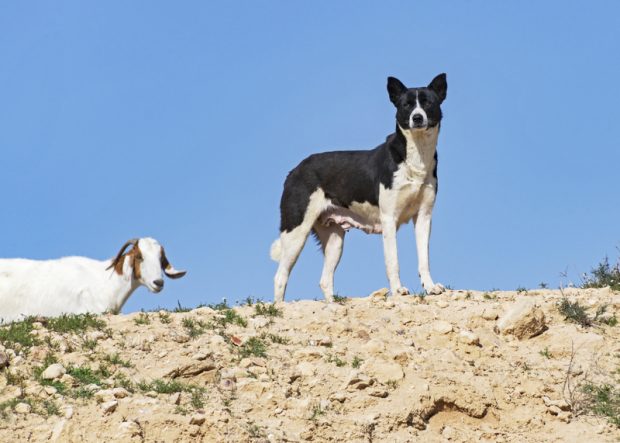
Interestingly, there is a breed that is singular in this way: No matter the registry (AKC, FCI, United Kennel Club, and Canadian Kennel Club), it has the only breed standard in which the word “distrustful” is used, and that breed is the Canaan Dog, the National Dog of Israel.
Readers who are “word smiths” know that words are nuanced, and “wary,” “suspicious,” and “distrustful” do not mean the same exact thing, especially when it comes to describing dog breeds and their behavioral traits toward strangers or unfamiliar people.
“Wary” describes a cautious attentiveness or alertness without immediate hostility. A wary dog is watchful and careful. He or she may not approach strangers readily, and they can appear aloof or reserved.
“Suspicious” suggests a stronger sense of doubt or mistrust about the intention of others. Suspicious dogs don’t just watch their surroundings cautiously, they may also interpret unfamiliar people or situations as potential threats and convey a readiness to act if the perceived danger is confirmed.
A somewhat stronger term than the other two is “distrustful” as it implies a lack of trust in strangers or new situations. Distrustful dogs may refuse to engage, show fear, or may rely on avoidance because at some level, they believe that a new person or situation is not safe.
In breed standards, these subtle distinctions help define behavioral expectations. Herding or guardian breeds who are described as “suspicious” assess and possibly challenge strangers as part of their protective role. A “wary” dog might show caution but not confront strangers, while a “distrustful” dog might shy away or show more fear-based reactions. These are important distinctions that help owners understand their dog, and tailor expectations by conformation judges and trainers.
A good question to ask is why the Canaan Dog is described as “distrustful” and not wary or suspicious, and one need only look at the breed’s history. The breed’s temperament is rooted in thousands of years of survival as a primitive, free-living pariah dog in the harsh deserts of the Middle East. Shaped more by natural selection than by targeted breeding, the breed developed a deeply ingrained lack of trust toward strangers as a crucial self-preservation trait, alongside high alertness and quick reactions. This “distrustful” nature goes beyond situational caution—seen in breeds labeled as suspicious or wary—reflecting an instinctive, emotional guardedness that is strongly defensive but not naturally aggressive. Unlike breeds whose wariness has been moderated through selective breeding for specific working roles, the Canaan Dog’s temperament remains close to its wild origins, making early, fair, and consistent socialization essential to help each Canaan Dog manage a deep-seated protective instinct in domestic settings. Note that this is an intelligent, loyal, and loving dog with his family, but trust must be earned and reinforced. It will be well rewarded.