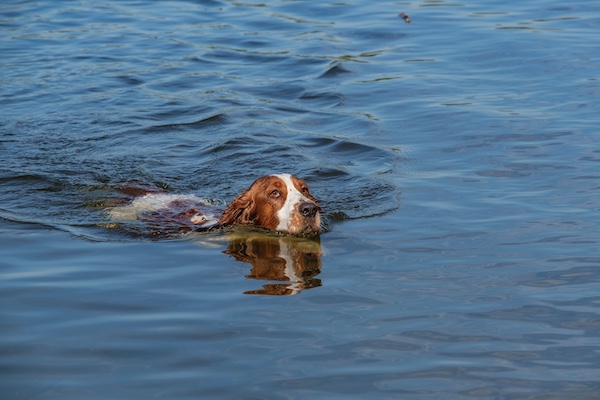
Not surprisingly, the Welsh Springer Spaniel’s name comes from springing game, and heckling rabbits and birds out of undergrowth for the falcon and later the gun. But the country in which it was bred to work wasn’t all dry hedgerow. These dogs worked brush thickets, rocky hills, deeply plowed furrows, and marshland, and that kind of country called for a good swimmer.
The Welsh Springer is a flushing spaniel, not a specialist retriever. Its traditional role was finding game in heavy cover and pushing it into the air, not waiting in a warm and cozy duck blind. While retrieving has always been part of the job, so has water.
The AKC describes the breed’s swimming ability, nose, and slightly webbed feet as qualities that make it a good water dog and retriever. The breed standard itself doesn’t mention webbing. It asks for feet that are round, tight, and well arched with thick pads, and this suits a dog that crosses mud, rock, and stubble in a single morning. The standard calls for a coat “sufficiently dense to be waterproof, thornproof, and weatherproof,” protective in heavy cover and weather without being so heavy that it hinders the work. It describes a dog “obviously built for hard work and endurance.” We like how Britain’s Welsh Springer Spaniel Club put it more simply: these dogs “love to get wet and mucky.”
Welsh Springer people don’t just say their dogs can swim. They test it. The Welsh Springer Spaniel Club of America’s Working Dog certificate requires a thrown dead bird retrieved from water with a shot fired, and the dog must swim for it. AKC spaniel hunting tests raise the bar at each level. A Junior Hunter retrieves a bird from water at 20 to 25 yards with a shot fired, and it may be gently held on the line and need only return the bird close to its handler. A Senior Hunter retrieves from 30 to 35 yards, delivers to hand, and must be steady on the line. A Master Hunter must be steady to wing and shot, retrieve a marked bird from water at 40 to 45 yards, and complete a separate blind retrieve across water. In the blind retrieve, the dog takes direction from its handler to a bird it never saw fall.
Writing for the Ladies Working Dog Group, Jane Sutherland of the Welsh Springer Spaniel Club of South Wales lists the breed’s jobs as beating, picking up, duck flighting, decoying pigeons from a hide, and following a blood trail after deer. She calls the Welsh “a tenacious game finder in hardcover and tough conditions” whose dogs “very rarely miss birds,” even ones hung up in clematis and twirly vines well above their heads.
On ducks, one of the most candid assessments appeared in Gun Dog magazine in 2006. In M.J. Nelson’s article “A Case of Mistaken Identity,” Welsh owner Randy Capsel calls Welshies “decent duck hunting dogs in the early and mid-season.” He adds that they “don’t have the coat for late-season duck hunting,” and that “for the most part, geese are too large for a Welsh springer to handle.” In other words, an early-season duck over a pond is within reach. Sustained cold-water waterfowling belongs to the specialist retrievers, dogs like the Chesapeake.
The breed’s real asset in the field is its nose more than its speed. An essay on the website of Britain’s Welsh Springer Spaniel Club says, “The power of their noses can’t be stressed enough – it dictates their working style.” The writer adds that Welsh Springers excel as game finders and line hunters, echoing the longtime breed authority Hal Leopard’s judgment that there is no better dog on runners. That kind of persistence matters whenever a wounded bird has to be recovered, whether it went down in bramble or in reeds. The WSSCA describes a dog that quarters at a brisk trot within gun range and works scent by alternating between the air and the ground. It often pauses briefly just before the flush, then drives in to put the bird up, in a pattern that is methodical “but is never a pottering action.”
This is not a turbocharged working English Springer, and the breed’s own people don’t pretend it is. Shooting UK considers the Welsh probably at its best in the beating line and notes that not every Welsh retrieves by instinct. The UK club’s essay describes the breed’s style as “often slower-paced and far more nose-dominated and scent sensitive.” It warns that “retrieving skills vary considerably, and may well have to be taught patiently over several months.” Water work follows the same rule. Hunt-test requirements make clear that steadiness on the line and a clean delivery to hand are trained skills, not gifts.
In the United States, Welsh Springers can’t enter AKC spaniel field trials, which are limited to Cockers, English Cockers, and English Springers. Instead they compete in AKC spaniel hunting tests. The breed has had notable recent successes elsewhere. At Crufts in 2023, River (Bowdonia Moon River JW), handled by co-owner and underkeeper Peri Burchmore, was overall winner of the BASC Gamekeepers’ Classes. That is a show class for working gundogs, judged on their appearance and conformation as working dogs. In 2026, at the Minority Breeds Team Challenge at The Game Fair, the Welsh Springer team won the spaniel competition ahead of the Clumbers. That event was judged on hunting, handling, stopping to shot, and retrieving in woodland and cover.
A protective coat, a strong nose, and the ability to swim suit this breed to the rough, often wet country it has always worked. A red-and-white spaniel coming out of a pond with a bird in its mouth isn’t out of place. It’s just finishing the job it started in the cover.
Image of a Welsh Springer Spaniel by fotocorn/Depositphotos