You will be forgiven if you’ve never heard of the Steekbaard, a rugged and bristly‑faced hunter that was once part of the rough, farm‑dog population of southern Africa. Translating from Afrikaans as “prickly beard” (from steek, to prick or sting, and baard, beard), the name captures the defining hard, “griffon‑like” coat of this historical working dog type. In the 19th and early 20th centuries, the vast landscapes of the veld demanded an all‑purpose and robust farm dog capable of withstanding scorching heat, covering long distances, and facing dangerous game.
The Steekbaard developed during the colonial era in South Africa as one of the rough-coated Boerhond (“farmer’s dog”) types, alongside the related Vuilbaard (“dirty” or “woolly beard”). While the Vuilbaard was associated with a shaggier, “dirty-bearded” appearance, the Steekbaard was distinguished by a coarse, stiff coat, often described by contemporaries as hard and griffon-like. These dogs arose from crosses between indigenous African dogs—such as the Khoikhoi or “Hottentot” dogs, which contributed a unique dorsal hair feature—and a mixture of European breeds brought by settlers, including mastiffs, Great Danes, Bloodhounds, Greyhounds, pointers and Irish Terriers. Epstein and other writers describe Boer dogs of this sort as Greyhound-sized, dirty-white or light-colored, sharp (keen), fast and hard-coated, used for big-game hunting and farm work. (Clarification: the reference is usually to zoologist H. Epstein, who wrote about African domestic animals in the mid-20th century.)
The prickly coat of the Steekbaard was favored by many Boer hunters, who valued a hard, weather‑resistant jacket in the thorny African bush. In practice, this made the Steekbaard a tough, multi‑purpose farm dog—used for guarding homesteads, assisting on the hunt (including lion hunting) and general work around the farm—rather than a narrowly specialized herding breed.
By the late 19th century, influential figures such as big‑game hunter Cornelius van Rooyen in what is now Zimbabwe were refining local Boer dogs into a more recognizable “lion‑dog” type. Cornelius and his contemporaries drew on the same rough and smooth Boerhond population that included Steekbaard‑type dogs, selecting for courage, stamina and hunting ability rather than for a single coat texture. Within this mixed population, some dogs carried a unique characteristic while others didn’t. Over time, breeders increasingly associated this characteristic with the emerging lion dog and began to favor it as a defining feature.
The Steekbaard as a recognizable rough‑coated type started to vanish with the rise of formal breed standards in the early 20th century. In 1922, when breeders in Bulawayo drew up the first standard for the so‑called Lion Dog, they described the coat as “short, hard, dense and fine, sleek and glossy in appearance, but neither woolly nor silky,” effectively excluding rough, woolly or griffon‑like coats from the ideal. As this “lion dog” developed under this standard, rough coats were treated as faults and progressively bred out of show lines.
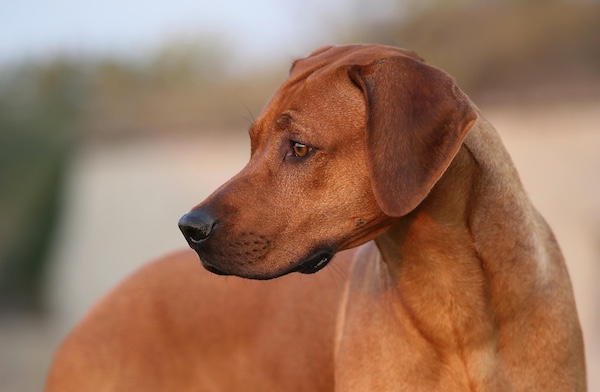
Today, it’s unlikely that you’ll ever encounter a true Steekbaard “prickly beard,” and the name itself survives mainly in historical texts rather than in living strains. Yet the genetic legacy of those rough, uniquely identified dogs —including the hard-coated Steekbaard and its kin—persists in the ancestry of the modern breed you know as the Rhodesian Ridgeback, and that unique characteristic is its ridge.
Image by u_m8a0uoye/Pixabay