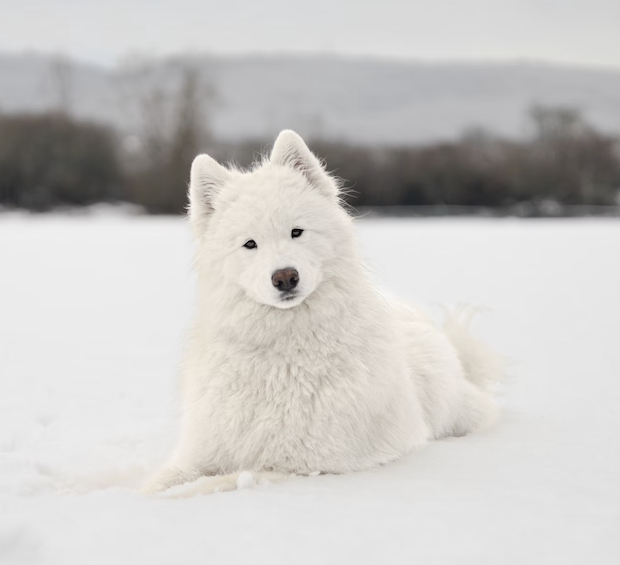
The much loved and stunning Samoyed is famously (and always has been) white.
Is that true?
The popular image of the Samoyed is one of a radiant white, fluffy dog, a reputation earned from the breed’s connection to the Samoyedic peoples of Siberia, particularly the Nenets tribe. These indigenous people bred dogs called “Bjelkier,” which means “white dog that breeds white.” The white coat was likely favored for the camouflage it provided in snowy landscapes, and its reflective property in a low summer sun. The Samoyed’s dense, double-layered coat—with silver-tipped guard hairs and a woolly undercoat—was essential for surviving the brutal Arctic winters. These dogs were not just working animals; they were considered family members, often sleeping with their people and providing warmth in the harsh conditions.
History, however, reveals a more nuanced picture. Not all dogs kept by the Samoyedic tribes were pure white because not all Samoyed tribes were nomadic. Samoyedic people included the Nenets, Enets, Nganasan, and Selkup, people who inhabited vast regions of Siberia from the White Sea to the Yenisei River. Diverse lifestyles and environments lead to different needs, and the dogs of these various groups may not have been subject to the same selective pressures for white coats.
As Robert and Dolly Ward wrote in their book, “The New Complete Samoyed,” pastoral tribes kept dogs of of the Renvall-Hund type, a term thought to have been derived from Swedish or German, meaning “reindeer dog” or similar, and these dogs bred to herd reindeer were more diverse in appearance, including their coat color. This is supported by historical records of early Samoyed imports to Europe, such as “Sabarka,” a brownish Samoyed brought back to England by explorer, Ernest Kilburn-Scott, in 1889. Other early foundation dogs like the cream-colored “Whitey Petchora” that Kilburn-Scott also brought back indicate there was more variety in coat colors than we of today might think.
Though the Samoyeds that Ernest had brought to England were not snow white, he and his wife, Clara, played a key role in popularizing white-coated Samoyeds by establishing the Farningham Kennels and helping create the 1909 English breed standard. They selectively bred the white-coated dogs to align with the Samoyed tribe’s Bjelkier ideal, which, in addition to being practical, appealed to Victorian-era aesthetics and the era’s romanticized image of Arctic dogs.
The Kilburn-Scotts’ work laid the foundation for modern Samoyed standards, which, while allowing cream and biscuit coats (per the AKC and UK Kennel Club), prioritize the white coat as the breed’s defining feature.
The persistent belief that the Samoyed has “always been white,” as initially questioned, oversimplifies a rich and intricate history. Rather than a fixed, unchanging trait, the Samoyed’s coat color evolved from the diverse practical and cultural needs of the Samoyedic tribes across Siberia to the refined white-coated standard shaped by early 20th-century breeders.
Image by Barcs Tamás
Though you virtually never see any color other than pure white in the show ring, the AKC standard says, “Color – Samoyeds should be pure white, white and biscuit, cream, or all biscuit. Any other colors disqualify.”