
Breed standards aren’t written for laymen. They are written for breeders, judges, exhibitors – and just maybe, the person who wants to know if their (fill in the breed name) is correct.
Still, for the novice wanting to be any of the above, it can be daunting to decipher some breed standards. More than once (and always in private), we’ve heard the words, “why can’t they write this in English?”
By way of comparison, any niche interest has a language all its own: Flea Flicker, fourth down, blind side, 3rd and 10, bootleg – anyone who follows football instantly recognizes these terms. The dog fancy is no different, but in this post, we’re going to drill down into specifics – proportions in particular – and use the wonderful Field Spaniel as an example.
In the section on Size, Proportion, and Substance, a portion of the AKC standard reads, “The ratio of length to height is approximately 7:6. (Length is measured on a level from the foremost point of the shoulder to the rearmost point of the buttocks).”
To make a point, we’ve omitted the third sentence (sorry, not sorry) that reads, “A well balanced dog [is] somewhat longer than tall” because we want to inspire some of you learn how to envision what the numbers mean. If you imagine the dog’s height as 6 units, and the length is 7 units, this means the dog should be more rectangular, not square.
At the risk of offending those of you who “get this,” please understand the newbie who wants to get this right.
But, some may ask, why is the ratio of length to height approximately 7:6, and not, say, 8:7 or 6:5?
A Field Spaniel is meant to be a balanced hunting gundog. Being slightly longer than tall gives them an elegant, ground-covering outline without looking too stretched out, something that would be lost if the proportions were pushed to 8:7 making the dog appear longer and lower and completely throw off the dog’s balance. If proportions were 6:5 ratio, the dog would be closer to square in shape which could make the Field Spaniel appear stockier or more compact. A 6:5 ratio would shorten the dog’s body relative to height, potentially restricting his or her stride length and reduce the dog’s ability to move with a steady, controlled pace, and perhaps with less agility.
When reading a standard, always remember what the breed was intended to do. The Field Spaniel was developed as a flushing spaniel, a working dog that functioned in thick cover at a steady, controlled pace. Such a dog needs enough length of body to move fluidly and with endurance; too much length could lead to a weak, saggy back. We know this because (if we read breed history correctly), there was a time in the late 19th century when many Field Spaniels were bred to be too long and too short-legged. The end result was that they were heavy – impractical for field work. Authors of the modern standard wisely avoided over-exaggeration while still keeping the breed’s silhouette intact.
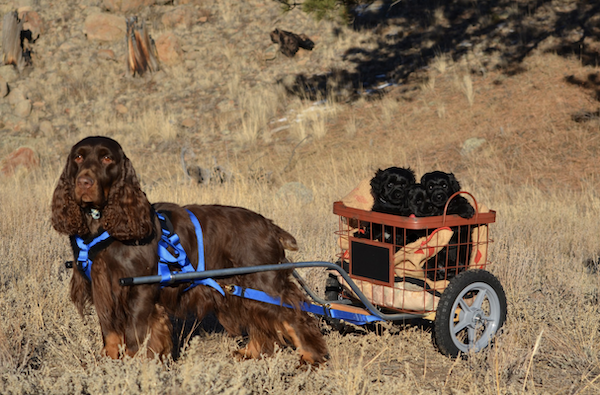
Our image is of “Mozzie,” a Field Spaniel with a basket full of PWD puppies. Mozzie was the first Field Spaniel with a draft title. Our thanks to Heather Hill Fiedler for sharing the photo with us back in 2023