“Not for nothing are they called sighthounds.” — Bud Boccone, dog historian and Managing Editor of the AKC Gazette, AKC Family Dog magazine (November/December 2010).
We love Bud’s quote, but we purposefully left off the first part of it.
In full, Bud wrote, “The coursing breeds—Greyhounds, Salukis, and other hounds developed to scan vast expanses of desert—are the prototypical visual streak breeds. Not for nothing are they called sighthounds.”
We omitted the first part because the visual streak is not limited to desert coursing breeds.
Research has shown that this retinal arrangement is strongly associated with long-nosed dogs (dolichocephalic dogs) more broadly. In this post, however, we are going to pay more attention to the sighthounds, and sorry, not sorry, but we might “geek out” a little as we talk about this remarkable retinal adaptation.
Why?
Because selective breeding influenced how these dogs process visual information. Put another way, breeders (knowingly or unknowingly) shaped not only what dogs looked like on the outside, but also how they perceived the world. Hunters needed a dog that could spot movement, chase it, and catch up. Far removed from modern science, tribesemen, whom we can thank for many of our sighthound breeds, noted over generations that long-nosed dogs “saw” better.
And they weren’t wrong.
Sighthounds have many “superpowers,” and one of the ones we most admire is their ability to detect movement across a broad horizontal field of view while in motion. This capability is associated with a horizontally oriented “visual streak,” a band of densely concentrated retinal ganglion cells aligned across the retina. Rather than concentrating visual acuity into one small central region, the visual streak spreads enhanced visual sensitivity across the horizon, helping these dogs scan the horizon and detect movement quickly, accurately, and unfortunately for the prey — efficiently.
We know this because studies by Dr. Paul McGreevy and his colleagues demonstrated that these retinal patterns are closely associated with skull shape. In wolves and many long-nosed breeds, the visual streak is pronounced and horizontally organized, an arrangement well suited to tracking movement across open landscapes.
In contrast, brachycephalic breeds tend to show a more centralized area of retinal specialization known as an area centralis, with a reduced or less prominent streak. What makes this especially fascinating is the degree of variation found within a single species. McGreevy’s work showed that domestic dogs exhibit unusually large differences in retinal organization linked to head shape, likely reflecting the intensity of human-directed selective breeding. Researchers mapped retinal cell distributions across multiple breeds and compared them with skull measurements including skull length, width, and cephalic index. By using wolves as their ancestral reference point, the studies showed rather vividly how selective breeding altered not only canine appearance, but aspects of internal sensory anatomy as well.
The result is a compelling example of form following function. Dogs bred to visually scan landscapes while pursuing game retained retinal arrangements that favor horizontal motion detection and peripheral awareness, while breeds developed for other purposes evolved different visual emphases. In other words, breed purpose helped shape not only canine structure and behavior, but vision itself.
For those who live with sighthounds, this is more than an interesting science lesson; it’s a reminder of just how precisely these dogs were shaped for their jobs. Our job is to stand back in awe. When we watch a Greyhound lock onto movement at what feels like an impossible distance, or see a Saluki or Pharaoh Hound effortlessly track something at the edge of our yard, we’re seeing thousands of years of human partnership written into the back of the eye. Appreciating that design deepens our respect for these breeds and underscores why preserving their form, function, and purpose matters so much
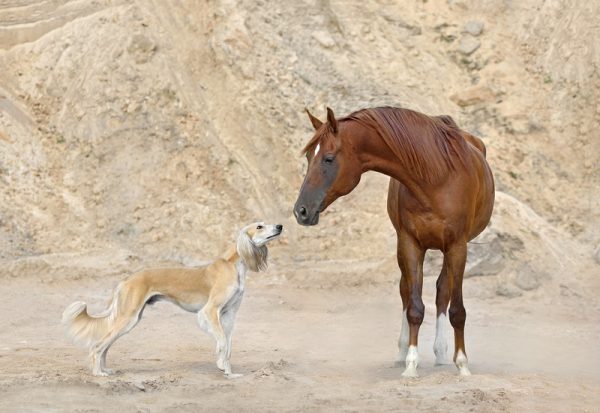
Image: Saluki with Arabian horse plotting world domination. By © Natallia Yaumenenka/Dreamstime
We are told that the saluki in the Arabian desert can look into the sun and see clearly.
It’s a marvelous bit of lore. That said, no dog — Saluki included — can actually stare directly into the sun without risking real eye damage; the biology just doesn’t allow it. We’d file this under gorgeous, telling folklore rather than literal fact. Thanks for sharing it — these little fragments of oral tradition are exactly the kind of breed trivia we love digging into.