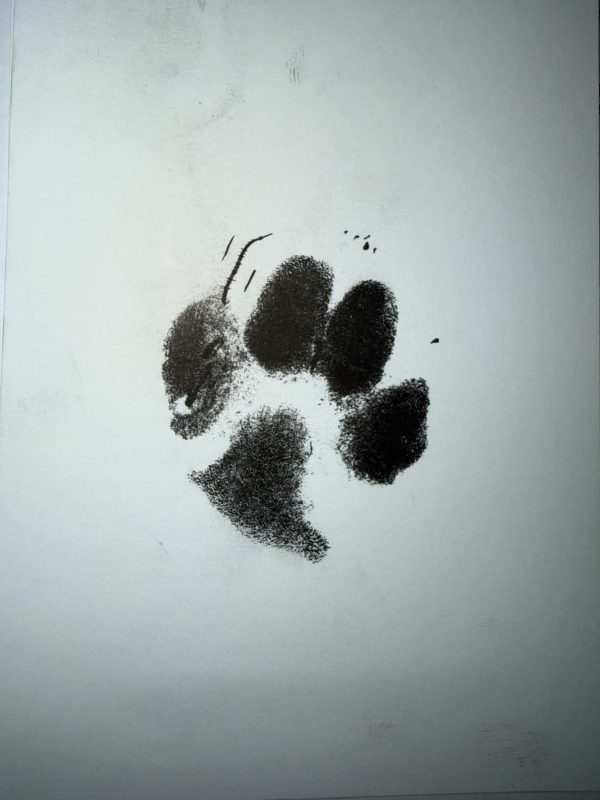
It happens a fair amount on these pages. We start researching one thing and soon find ourselves down a rabbit hole with another. And it all began with a reader who shared a photo of a paw print from her dog’s “pyrame” paw:
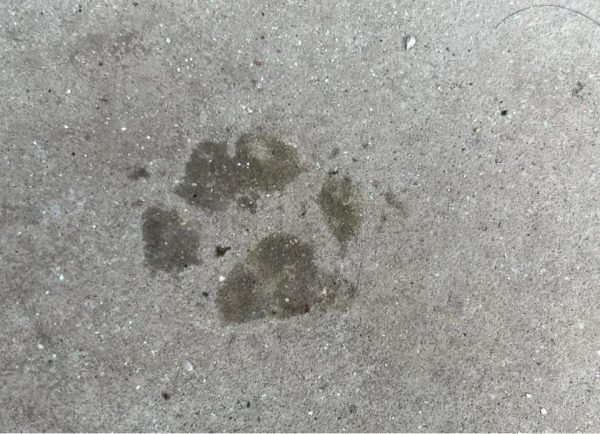
Despite decades in the dog world, we were unfamiliar with the term, and thus began our research.
We hadn’t gotten very far into learning that the term is another word for the harmless genetic condition known as syndactyly, or fused toes, before we wondered where the term, “pyrame” came from. It is here where we invite you to fall into the rabbit hole we fell into.
We learned that the word “Pyrame” didn’t start out as a label for a foot at all. It first showed up in older dog literature as the name for a particular kind of small spaniel, and more specifically, a dark toy spaniel sometimes described as black or black-and-tan. As far as we can tell, these dogs were in the same broad family of toy spaniels that later became associated with the early King Charles Spaniels. Put another way, “Pyrame” began as a name for a dog, not a diagnosis for a foot.
It was 18th-century writer Georges-Louis Leclerc, Comte de Buffon, who used the words Gredin and Pyrame for small spaniels in his Histoire naturelle. Later summaries of that work state that he applied the name “Pyrame” to spaniels with “fire-colored” spots above the eyes, on the muzzle, throat, and legs—a theme repeated by a number of 19th-century English writers, including Vero Shaw in The Illustrated Book of the Dog, and again in the 20th century by Judith Blunt-Lytton (Lady Wentworth) in Toy Dogs and Their Ancestors.
In toto, the texts and illustrations focused on the dog’s small size and dark coat rather than spelling out an exact color formula, and while they never explained why that particular name was chosen, we found that in the world of literature, “Pyrame” was also simply the French form of Pyramus from the story Pyrame et Thisbé. In Ovid’s telling of that myth, Pyramus’s blood stains the white mulberry fruit a deep red-purple. It is not a leap to see the coincidence of a dark, richly marked spaniel sharing a name with a tragic figure whose blood permanently colors pale fruit, but we found no historical dog texts to prove that Buffon or any of his contemporaries had this myth in mind.
Feet enter the story much later, and closer to home for toy spaniel people. As of this writing, there is only one AKC breed standard that uses the word “fused” with regard to feet, and that is the English Toy Spaniel. From the standard: Feet, front and rear, are neat and compact; fused toes are often seen and are acceptable.
It does not mention the term “Pyrame,” but the extended breed standard of the King Charles Spaniel for the Australian National Kennel Council does.
Wait, some of you may be saying. “Weren’t we just talking about the English Toy Spaniel?”
Yes, we were. In the United States, the American Kennel Club calls the breed the English Toy Spaniel, while in the United Kingdom the same breed is registered by The Kennel Club as the King Charles Spaniel. The Cavalier King Charles Spaniel is a separate breed in both countries, developed in the 20th century in an effort to restore the older, longer-muzzled toy spaniel type seen in many historic European paintings.
But we digress.
In the context of feet, some contemporary writers began to use the expression “Pyrame feet” as shorthand for this fused-toe trait. Perhaps coincidentally, many fanciers noticed fused toes in black-and-tan English Toys and associated the trait with that variety, but we found no evidence that coat color is genetically linked to fused toes. The two features simply seem to appear together in some of the same old lines, but if any readers know differently, we are keen to hear it.
That said, it so happens that the paw print seen above was made by George, the dog you see below:

Meet George, aka Triple Gr Ch (Neuter) (T) (TS) Multi Ch (Neuter) (R) (T) (TS) Cavildown Prince George RAE FS.N HTM.N. George is from Victoria, Australia and is the first “Charlie” (ETS for we Yanks in the US) to earn any kind of sports title in Australia
We are told that when a judge picks up a dog’s foot and examines the toes, it is a strong suggestion that the judge has done their homework. What they are looking for is a compact, neat, well-padded paw with strong pasterns. They will not run out of the ring with their hair on fire if they find fused toes, because they are often seen and are entirely acceptable. In George’s home country, the extended guide indicates that the “much-prized Pyrame foot or feet” may be seen on one, two, three, or four feet. Seeing it on a fifth foot is an instant disqualification.
Cue chuckles.
We conclude with a shoulder shrug. We came across some terrific breed folk tales regarding the pyrame foot and color, and we use the term “folk tales” reluctantly because we are very fond of oral histories, mythologies, and legends. But when we cannot prove that a story is any of the above, we have to relegate it to folk tale status until we can demonstrate otherwise.
It will not stop us from sharing it, however.
As the story goes, Charles II’s beloved sister, Henrietta-Anne, was married into the French court and favored a now-extinct little black water dog called the Pyrame, said to have webbed feet, fused toes, and even double toenails. In one’s imagination, it is not hard to picture Henrietta’s Pyrames and Charles’s own toy spaniels sharing more than a few quiet trysts around the royal apartments. In this telling, the most prized feature was those fused toes and double claws—the living “mark of distinction,” an inheritance whispered down from the Pyrame.
Henrietta died tragically at the age of 26. She fell violently ill after drinking a cup of chicory water and died within hours. Rumors spread, but the official autopsy attributed her death to natural causes, which modern historians often believe was a ruptured ulcer or peritonitis.
As the story continues, her lady-in-waiting, Louise de Keroualle, gathered up the little dogs and moved to London, where she became Charles’s longtime mistress. Charles kept his women and his spaniels close: mistresses were ensconced within “strolling” distance, and a “rippling sea” of toy spaniels flowed everywhere he went—through Whitehall, along Birdcage Walk, and in and out of bedchambers. Breeding at court, the story adds (and not without a bit of insolence), was as indiscriminate among the dogs as it was among the people, and the famous “Beware of the Dogs” signs supposedly meant “mind your step—they are underfoot or whelping,” not “they might bite.”
We will never see a “Beware of the Dog” sign the same way again.
Before her passing, it is said that Princess Henrietta brought these specific French Pyrame (black-and-tan) spaniels to the English royal court—dogs that carried the benign genetic mutation for syndactyly (fused toes).
What began as a simple question about a curious paw has taken us from kennel-side observations to 18th-century naturalists, from myth to monarchy, and back again to the dogs at our feet. Whether “Pyrame” is a linguistic relic, a poetic borrowing, or a fragment of breed lore that refused to fade, it reminds us how much of dog history lives in the space between what can be proven and what is simply passed along. For now, the fused toes themselves remain the only verifiable constant—quiet, harmless, and still turning up in the same small spaniels that have charmed their way through centuries. And if nothing else, the next time someone mentions a “pyrame paw,” we will all know there is far more behind it than meets the eye.
Images: We are indebted to Penny Windlow for “luring” us down this path, and for allowing us to share the wonderful photos of George and his fused toes.
That was a great read I was the breeder of George , I had one King Charles Spaniel with all 4paws with fused toes , they are very hard to cut , Penny has done a wonderful job with George and I am so proud of them both
That is so appreciated, Pam, thank you! He’s lovely