Note: The photo is not of a boar.
So when we write that as a rule, they are shy and tend to avoid people, but if you get in their face, watch out, it’s not the dog.
In a recent year, Japan’s Ministry of the Environment recorded around 90 people injured in wild‑boar incidents – ‘events’ that often involve the Ryukyu wild boar, and a small number of attacks each decade are fatal. When roughly 150 pounds of pork come at you at about 25 miles per hour, bet on the pig.
And yes, we know that pigs and boars are not the same.
And ferocity meets quantity. These boar can give birth up to twice a year, and each litter can have 4–6 piglets. Boar‑lets. Whatever.
And here we wildly digress because we love pig trivia. And yes, we know (say it with us).
Did you know that in hunting terminology, boars are given different designations according to their age?
Squeaker – 0–10 months
Juvenile – 10–12 months
Pig of the sounder – second year
Boar of the 3rd/4th/5th year – 3rd–5th years
Old boar – sixth year
Grand old boar – probably our age as we write.
And who wouldn’t want to own a “squeaker”?
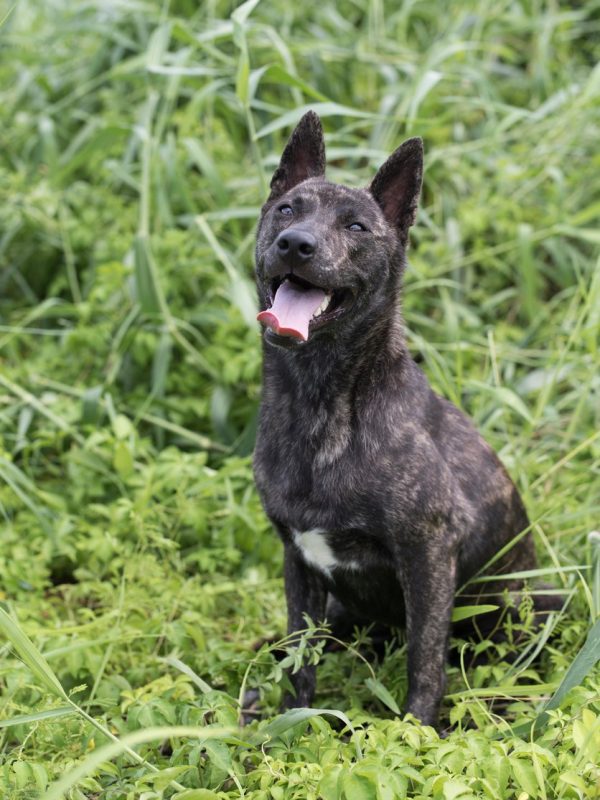
Now meet the Ryukyu Inu. In its home forests, the breed is best known as a boar dog—developed to track and hold Ryukyuan wild boar—though its nose and prey drive make it effective on other game as well. You have to respect a dog that doesn’t respect the pig.
And yes, we know that pigs and boars are not the same.
There are two prominent lines of this rare Japanese breed: the Yanbaru, associated with the northern forests of Okinawa Island, and the Yaeyama, associated with the southern islands. The Yanbaru line is described as stockier, thicker‑built, and shorter, while the Yaeyama line is taller, leaner, and less stocky, with average heights of about 18 inches for Yanbaru dogs and about 19½ inches for Yaeyama dogs at the shoulder. That said, hunters value correct type, courage, and nose over which line a dog comes from, and with such a small gene pool, any sound, game‑keen Ryukyu Inu is a treasure in the field.
For all that, the Ryukyu Inu occupies an odd place in the Japanese dog world. It is maintained by its own preservation society, the Ryukyu Inu Hozonkai in Okinawa, but it isn’t recognized by the Japanese Kennel Club or by the Nihon Ken Hozonkai (NIPPO), the body that oversees the six classic Nihon Ken—Akita, Shiba, Kishu, Shikoku, Kai, and Hokkaido—designated as natural monuments. As far as we can tell, part of the reason is political and practical: the Ryukyu developed on the Ryukyu Islands rather than on Japan’s main islands, the modern population was rebuilt from a small, fragmented remnant in the 1980s, and its numbers are still so low that the focus has been on survival and type preservation rather than meeting the paperwork and demands of a national kennel club. For now, anyone wanting to meet a “papered” Ryukyu Inu is advised to go through the Okinawan preservation club, not through Tokyo. The breed’s legitimacy lives with the local preservation society on its home islands.
That local control comes with a cost: a tiny, tightly related gene pool where every breeding decision matters, and where preserving health and working instinct is a harder fight than facing any boar.