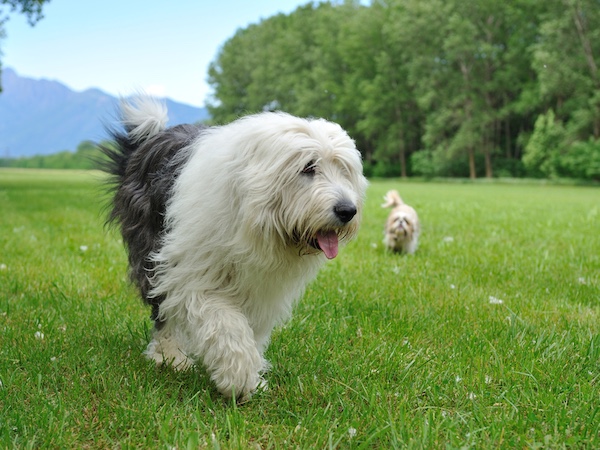
The Old English Sheepdog famously ambles or paces when gaiting at slower speeds (though it is not required), and as of this writing, it remains the only AKC breed to mention amble in its breed standard.
But where did the word even come from in the contest of dogs?
It comes from a source that impacts much of what we know about canine movement, as well as its terminology: The equine world.
Early writers and judges in the canine world leaned heavily on horse terminology when describing movement and structure, so words like pace, trot, reach, drive, hock, and withers migrated into dog vocabulary. The word, amble described a specific lateral, two-beat gait in horses — smoother than a trot, often used over long distances because it conserves energy and causes less vertical motion.
“Amble” shows up in the Old English Sheepdog standard because those early experts drew from horse models when explaining and evaluating how dogs moved, especially large, pastoral breeds like the OES which retained the reference.
In their incredibly useful book, The Art and Science of Judging Dogs, Curtis and Thelma Brown describe ambling as a walk where the dog’s footfall is nearly – but not exactly – as its pace (they add that its characteristic roll is a result not of moving with its feet wide apart, but because of flexible joints that make the OES an agile breed). It’s an intermediate between a true walk and pacing, a relaxed and easy two-time lateral gait. Jane Harvey describes this as when two legs on one side move together and then the two legs on the other side move together.
Because different wording resonates with different people, consider it this way: It’s a transitional gait between a walk and faster movement, and there is a brief phase when three feet are in contact with the ground and providing support. In this gait, the hind foot leads the front foot by a split second. According to the Encyclopedia of K-9 Terminology, the interval is about 0.06 seconds in most breeds – less than half the time it takes to blink an eye.
A sound Old English has a combination of angulated and balanced limbs, low-set hocks, well-developed second thighs, broad hindquarters, and compact feet. These traits provide both the strength and coordination needed for the breed’s characteristic ambling or rolling gait, allowing the dog to transition smoothly between walking and faster gaits without losing balance or stamina. With a flexible spine and powerful loin, the Old English moves in a smooth, almost rocking rhythm, each hind foot landing just ahead of its forefoot. This effortless amble enabled these drovers to stride alongside sheep for long distances, covering ground with both endurance and elegance.
Image by ©Dmitrijs Gerciks/Dreamstime