Anyone who calls the Posavac Hound a “valley and thicket” scenthound is worth listening to because they know. The phrase neatly captures both the land that made the dog and the dog that was made for that land. The “valley” is a nod to the name Posavac, which is usually rendered in English as “scenthound from the Sava Valley,” referring to Croatia’s Posavina region along the Sava River. The “thicket” is what hunters actually push through in that basin: the kind of country that can mean dense underbrush, heavy briars and brambles, swamps, and thick, flooded forests. Miserable conditions for many dogs.
The “valley and thicket” Posavac Hound, then, is well adapted to hunt this specific environment. Not a tall, leggy hound built for sheer speed on open plains, nor a short‑legged hound bred for low‑ground burrowing, the Posavac has an agile but robust, slightly elongated build that hits a structural sweet spot. Its body is clearly longer than it is tall, with enough substance and balance to stay sure‑footed and working all day in punishing brushwood and marsh, yet enough leg and speed to stay with fast game like hare and fox when the chase breaks into more open ground. The United Kennel Club describes the breed as a good scenthound with excellent stamina, used for hare and fox, and also usable as a trailing leash hound.
But why does a hunter choose this breed above other Balkan or European scenthounds with a similar skill set, such as the Istrian Shorthaired Hound or the Serbian Hound? As far as we can tell, it’s not one dramatic superpower, but a particular balance of them.
The Posavac is especially noted for a clear, carrying, melodic voice. That voice isn’t just loudness, it is information. A handler can locate and “map” his dog by ear—hearing when the hound has picked up the line, when it checks, when game turns, and when the chase begins to press—long before he sees the dog emerge from cover. In this regard, the Posavac has much in common with coonhounds of the American South.
Then there is how the dog uses its body. The Posavac is neither too much dog nor too little dog. It has enough leg and stamina to stay on a hare or fox, but not so much size and speed that it constantly outruns the hunter or the country. Some hounds “run big,” meaning they range far, push hard, and may take a line deep into the distance before the hunter ever catches up—a real asset in broad, open country. In tangled river‑bottom cover, however, a dog that runs too big can become a liability. The ideal Posavac is not a specialist for sheer range, but a practical, enduring hound bred to work honestly in varied, often difficult country.
The Posavac’s value is that it is, at heart, a practical hound. It is built to work where scent lies in damp ground, where game doubles back through cover—most classically hare and fox, and in some accounts other game as well—and where the hunter may hear the dog long before he sees it. This is why voice matters so much. A clear, carrying voice is not decoration in a scenthound; it is communication. In thick brush, the hound’s voice tells the hunter where the chase is moving, whether the dog is pushing the line honestly, and whether the game is circling back.
Temperament is part of the equation, too. Breed standards and working accounts describe the Posavac as docile, good‑natured, and very attached to its owner, yet absolutely enthusiastic in the hunt. Some scenthounds with comparable grit can be a challenge for people expecting easy biddability. The Posavac Hound, by contrast, is often praised for a distinct dual nature: a relentless, eager worker in the field, and a gentle, affectionate, deeply bonded dog at home. For a hunter who wants a dog that will give his or her all in rough country and still live peaceably in the house, that combination is not nothing.
Versatility at the “nose end” rounds this out. While they excel as free‑running trailers for small game, Posavci also have the concentration and scent discrimination to work as leash hounds, tracking under close control. That leash‑hound ability also lends itself to controlled tracking work, including recovery tracking where local hunting practice permits it, drawing on the same steady nose and persistence that serve them so well on hare and fox.
Taken together, this may be what sets the breed apart from other scenthound with similar résumés. The Posavac Hound is not the flashiest hound in Europe, and maybe that’s the point. It is a valley dog, a thicket dog, a working hunter’s dog: robust without being cumbersome, keen without being frantic, persistent without being unmanageable, and soft‑hearted enough to curl up quietly when the day is over. Again, we mention the particular balance of desirable qualities.
In other words, the Posavac Hound was not designed to impress a map. It was designed to read one with its nose.
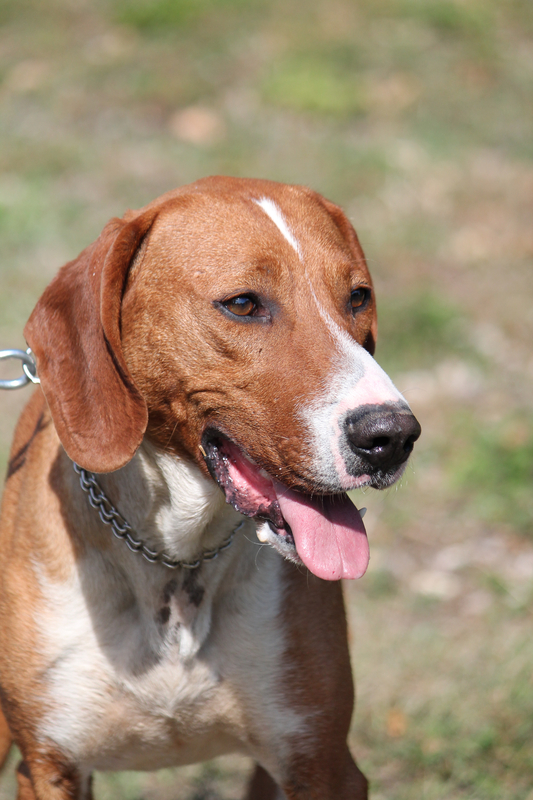
Photo of a Posavac Hound by Damir Čutura/Dreamstime