
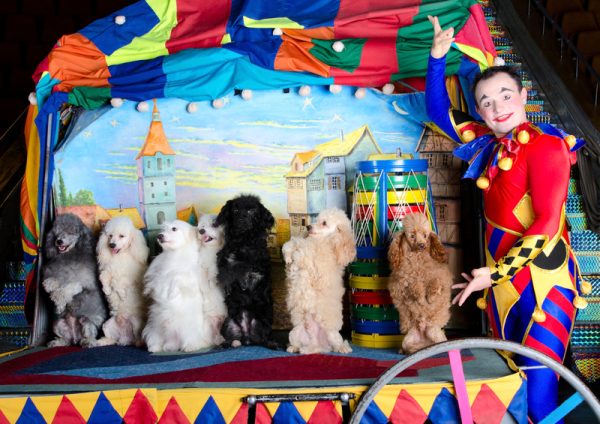
Spot the Poodle in the etching below:
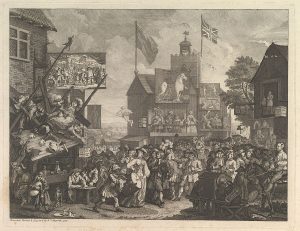
The image of Southwark Fair is an etching by William Hogarth which is now in the public domain.
We owe you a confession right off the bat. You won’t find one because while our post includes Poodles, no image of Southwark Fair exists that includes them.
But the sepia-toned etching makes it easy to imagine standing in the midst of the scene it depicts, Southwark Fair, just south of the Thames, in the early 1700s. The place had a reputation as one of London’s noisiest, chaotic and probably most “fragrant” places, and as it happens, it was also one of the most theatrical gatherings. It drew rope-dancers, puppet booths, musicians, gamblers, and all manner of animal “curiosities” until authorities finally closed it in 1762 as a public nuisance. Among the showmen working this crowded scene was a puppet-showman named Crawley who, looking to give his booth an edge over the competition, expanded beyond wooden marionettes and introduced a troupe of performing dogs—described in later accounts as Poodles—in a spectacle he billed as “The Ball of Little Dogs.”
To dress his canine dancers in a bit of Continental glamour, Crawley’s advertisements leaned on two reliable crowd-pleasers: foreign origin and royal favor. The surviving bill, as quoted by later antiquarians, stated that the dogs came from Lovain/Louvain and had performed before Queen Anne and much of the nobility. At the heart of the show were two star dogs with gloriously inflated titles: the Marquis of Gaillerdain and his “mistress,” Madame de Poncette—her name variously rendered as Poncette or Poucette in later retellings. The dogs were described as dancing to live music with remarkable precision, keeping time and cadence in a way that clearly impressed audiences of the day.
Much of what later dog writers repeat about “The Ball of Little Dogs” comes through Rawdon Briggs Lee (1845–1908), an influential English dog breeder, journalist, and long-time kennel editor of The Field. In his 1894 volume, A History and Description of the Modern Dogs of Great Britain and Ireland (Non-Sporting Division), Lee folded Crawley’s troupe into his discussion of the Poodle’s intelligence and trainability. He recounts Crawley’s claims about the dogs’ origins in Louvain and their performance before Queen Anne and the nobility, adding the wry observation that “even then we had a taste for something foreign.” He goes on to describe the Marquis of Gaillerdain and Madame de Poncette as dancing with “extraordinary training,” their movements neatly keeping time with the accompanying music—evidence, in his view, that people had been exploiting the Poodle’s aptitude for complex performance work for centuries.
Top image: Poodles by © Zakaz | Dreamstime