Veteran readers know of our fondness for breed‑related trivia, and of our penchant for tying language to any of the world’s glorious array of dog breeds when possible. When we read that one of the Karelian Bear Dog’s older names—Komi dog and “Dog of Zyrians”—was related to the Finno‑Ugric Komi (also known historically as Zyrian) people who brought their tough little hunting spitzes west from the Ural region, we couldn’t resist following the linguistic scent trail.
“Finno‑Ugric” likely rings a bell for Hungarians, or those of Hungarian extraction, because linguists treat Hungarian as part of the Ugric branch of the Finno‑Ugric group within the Uralic language family. In practical terms, that means Hungarian is related—distantly—to Finnish and Estonian, and more closely to the Ob‑Ugric languages Mansi and Khanty, spoken in western Siberia.
The FCI breed standard tells us that the origin of the breed is considered to be the Komi dog (aka “dog of Zyrians”), a hardy, regional hunting spitz kept by the Finno‑Ugric Komi/Zyrian people. These dogs were not a registry “breed” in the modern sense, but a landrace: tough, medium‑sized, prick‑eared dogs used to hunt bear, elk, and other game across the forests stretching from the Urals toward Karelia. Closely related hunting spitzes were much the same—a rough‑and‑ready landrace of fox‑eyed, prick‑eared, curled‑tail hunters spread across Karelia and neighboring parts of Finland and Russia. They were bred first and foremost to find and hold game—birds, small game, elk, and sometimes bear—and if this job description sounds familiar, it’s because many of these versatile dogs belonged to a broader complex of northern Eurasian hunting spitzes from which several modern breeds were later standardized, including the Karelian Bear Dog, Finnish Spitz, Norrbottenspets, and various Laika breeds.
We pivot back to the Karelian Bear Dog to share that, in the early 20th century, Finnish hunters and breeders saw value in fixing a distinct, powerful dog dedicated to big game—especially bear—instead of relying on whatever local spitz happened to be available. Under the guidance of determined fanciers and the Finnish kennel organization, they began in the 1930s to gather the best black and black‑and‑white bear dogs from Karelian and Komi stock, breeding specifically for courage, tenacity, and a steady bark‑on‑game style that would hold dangerous quarry at bay until the hunter arrived. By the mid‑1940s, their efforts had been formalized in a written standard and an official name—Karelian Bear Dog—turning a once‑loosely defined landrace into the bear specialist we know today.
And if you’re like us and wonder why the focus was on black and black‑and‑white dogs, and not on the reds, greys, and other shades that also existed in the ancestral population, the reasoning was intentional rather than accidental. Early Finnish breeders had access to a fairly colorful landrace—red, red‑grey, wolf‑grey, black‑and‑tan, black, and black‑and‑white—but they preferred the black and black‑and‑white dogs that best matched their idea of a serious bear dog, and those dogs were used most heavily as foundation stock. Once the first standard established in the 1940s described a dark dog with specific white markings, subsequent breeders leaned into that look, and today’s FCI and AKC language reflects that choice: a black dog (with acceptable variation in sheen) with clearly defined white markings on the head, neck, chest, belly, and legs.
We had promised earlier to probe a connection between the breed’s name and itsDoes the
There isn’t one — at least not in any tidy, storybook way for which we were hoping.
In the 1930s and 40s, when Finnish fanciers and the national kennel organization gathered and standardized these black hunting spitzes, they chose the name Karelian Bear Dog (Karjalankarhukoira) quite literally: “Karelian” to anchor the breed in its long‑standing hunting heartland, and “Bear Dog” to signal its specialty and reputation on big game. The Karelian Bear Dog’s name is rooted in Karelia and its bear‑hunting purpose, while Hungarian merely shares a distant linguistic cousinship with the Komi people who once bred the landrace behind today’s dog.
Still, even a tenuous thread is enough for us to bring you along on the detour, and to be reminded that sometimes our favorite breeds sit at the crossroads of languages, peoples, and histories that only briefly intersect.
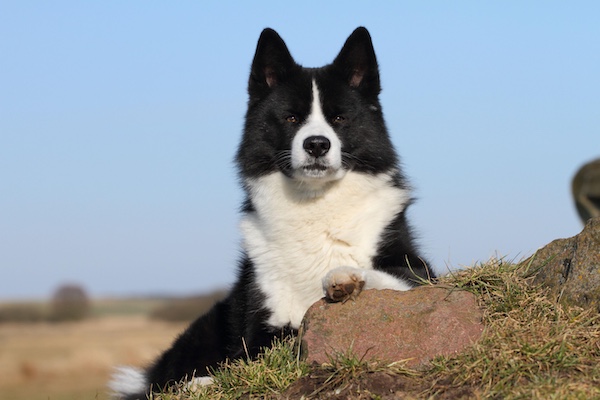
Image of a Karelian Bear Dog by Tierfotoagentur/Alamy