
Fun fact: the emblem that gave the “Dog-Heads” their name almost wasn’t a dog at all — it started as a pair of boots. But we’re getting ahead of ourselves. Let’s back up and meet the breed first.
The Bohemian Shepherd, known in Czech as the Chodský pes, is an ancient working dog from the Chod region of southwestern Bohemia, tied for centuries to a people called the Chodové. Some breed history chronicles from the reign of Duke Břetislav I already mention the Chodové traveling with an especially faithful dog. Later, during the reign of King Ottokar II (1253-1278), according to one long-standing theory, Bohemia recruited the Chodové from Carpathian enclaves near today’s Slovakia, Poland, and southwestern Ukraine, resettling them along the Bohemia-Bavaria border as frontier guards — though historians still debate this, and some argue the Chodové were already local to the region rather than transplanted. We leave that to breed historians to sort.
Whether that original dog was the same breed we know today, or one that developed shortly after, period drawings show a small, long-haired, prick-eared shepherd working right alongside them — patrolling, herding, and tracking game. By 1325, King John of Luxembourg formalized what the dogs had already earned: the Chodové’s right to own large dogs, a privilege ordinary Bohemian peasants didn’t have. Even after their agreement with the crown was voided in 1695, the dog stayed tied to their name.
Which brings us back to that flag.
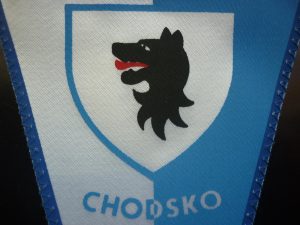
Chod pennant featuring the traditional black sheepdog-head silhouette on a shield, labeled “CHODSKO.” (Aukro.cz)
The nickname “Dog-Heads” (Psohlavci) comes from the writer J.A. Gabriel, who documented it in 1864 while describing the pennants used by the Chodové, said to carry the silhouette of a sheepdog. Here’s the twist: a regional Czech history source notes that the Chodové’s original seal and banner actually featured a pair of felt boots, not a dog, and that the dog silhouette was substituted in during the 19th century Czech National Revival — a period known for romanticizing national folk symbols. The timing fits: that’s right around the time Gabriel was writing. So the dog on the flag may be more 19th-century storytelling than medieval fact — but the working bond between the Chodové and their dogs was very real, and it’s that partnership, not the flag redesign, that gave the nickname its staying power. Either way, we like the idea of it..
Then came the setback that nearly ended the breed: following World War II, the breed nearly vanished. It took until 1984 for cynologists to launch dedicated breeding programs, producing the first modern litter in 1985 and closing the studbook in 2000.
And here’s the thing about a Bohemian Shepherd today — that centuries-old working spirit never fully grew up. These dogs can be laser-focused in obedience, scent work, or agility one minute, then hauling a toy around the house the next, inventing their own games and lobbying hard for “one more round.” In other words, they can be goobers. Owners quickly learn that putting toys away is a losing battle. The dogs hear everything, read body language like they’re fluent in it, and that sensitivity is exactly why they excel at performance work.
That same devotion drove a small group of owners to found a breed club and push for North American recognition — by 2023, an estimated 100 Bohemian Shepherds lived in North America (though some sources dispute that number). What started as a handful of owners trying to save a nearly-forgotten Czech farm dog has since grown into an organized push toward full AKC recognition — proof that centuries after a duke’s chronicler first noted a “faithful dog” at the Chodové’s side, that same loyalty is still finding new people to devote themselves to it. It should be noted that the breed is now, as we write, a member of the AKC Foundation Stock Service.
Top image of a Bohemian Shepherd puppy by Photomecan/Alamy