If the dog fancy borrowed terms from the equine world (and it did), it’s equally fair to say the terrier-and-vermin world shares its “catch dog” term with the far older tradition of big-game and hog hunting — even though the two-dog division of labor it describes isn’t unique to ratting at all. What ratting terriers add is a second label, “push dog,” for a version of the flushing role scaled down to fit a rat in a trash pile rather than a hog in the brush.
Long before Richard Reynolds’ R.A.T.S. (Ryders Alley Trencher Fed Society) took on Manhattan and Washington D.C.’s ratting collective, the RATscallions, terrorized rats of the capital, “catch dog” was already documented in American usage by at least the mid-1800s. “Push dog” carries no comparable pedigree — no documented instance turned up in the old bay-and-catch vocabulary of hog hunting, nor in any Victorian ratting record reviewed for this piece. It surfaces only in modern accounts of R.A.T.S. and its peers, suggesting it isn’t an inherited hunting term at all, but a coinage native to the urban ratting scene — built by analogy to “catch dog” to label a role that older hunting traditions already had, just under a different name and worked differently.
Hog hunting has always used a comparable two-dog system: a bay or strike dog corners the animal from a distance by voice, then a catch dog moves in to seize it. Ratting’s version compresses that into closer, dirtier quarters. A push dog doesn’t corner from afar — it burrows nose-first into garbage bags, trash piles, and debris to root the rat out by scent and drive it into the open. A catch dog waits, watches, and closes the kill with lightning speed; a push dog does the “grunt work” of finding the rat in the first place — the terrier equivalent of a flusher, not a finisher.
The Bedlington is a catch dog extraordinaire. Reynolds puts a number on just how much force is behind the bite: canine-tip pressure that, by his own estimate, can climb toward 1,200 pounds per square inch — and one describing pressure at the tooth tip specifically (Reynolds, Showsight, “A Secondhand Dog”). By his account, it isn’t the bite alone that dispatches a rat — it’s the shake that follows. One plausible read of the mechanics: that tip pressure may act as the anchor that lets the shake’s torque transfer into the rat’s neck rather than the dog losing its grip mid-motion, though that’s our inference from the described sequence, not something demonstrated in the source itself. Reynolds is direct about how the sequence plays out when a dog is working well: catch, a hard shake, a broken neck, and straight on to the next rat — though he’s quick to add that it doesn’t always go that cleanly (Fox5NY).
Quick, decisive, and — compared to anticoagulant poison or glue traps — a more humane and less prolonged demise.
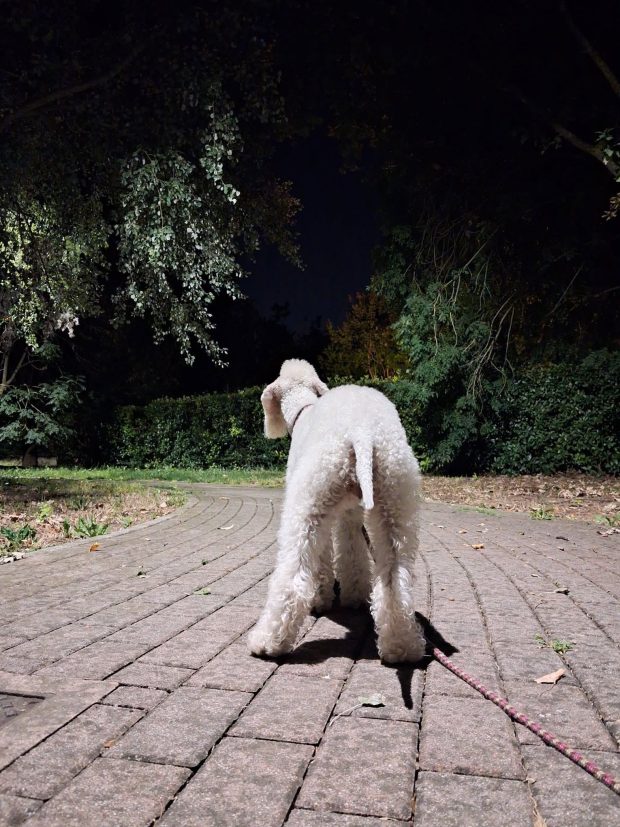
We remind new readers that despite the Bedlington Terrier’s lamb-like appearance, a show groom professionals consistently call one of the hardest coats in all of grooming, the leading theory holds that much of the trim’s shape — from the topknot and facial “fall” to the ear tassels and shaved face, throat, and skull — evolved to minimize anything a vermin’s jaws could grab onto during a scuffle, and to keep the dog’s head streamlined for squeezing into burrows and tunnels. The Bedlington Terrier Club of America’s own president has called the grooming style’s true origin “something of a mystery,” but the theory makes sense to us.
But in the end, it is the breed’s punishing “shake and break” strategy that makes it such an effective ratter: not a drawn-out fight, not a slow kill, but one decisive motion that ends things before the rat even registers what’s happened.
Be sure to visit Richard Reynolds’ Facebook page!
**Rattus norvegicus is the real, formally recognized scientific (binomial) name for the brown rat — also called the Norway rat, common rat, or sewer rat — first assigned by naturalist John Berkenhout in 1769. Despite the name, the species didn’t actually originate in Norway; the label stuck from an 18th-century misconception that the rat arrived in Britain aboard Norwegian ships. Agnus ratticida, by contrast, is not a real taxonomic name — it’s a fabricated Latin-style designation we invented for this piece, built from “agnus” (Latin for lamb) and “ratticida” (a playful “-cida” suffix meaning “killer of,” as in homicide or regicide) to capture the Bedlington’s paradox: a dog styled to look like a lamb that functions as a precise and lethal ratter.