As we recover from the Fargo Flu (so named only because we fell ill with it during a visit to that fine city; truth is, we caught the bug before we ever left the airport), we are at least grateful not to have the collywobbles.
Collywobbles, a marvelous 19th-century word, describes stomach pain or queasiness. Chills and coughing are enough, thank you very much. The word, however, brings to mind other terms we do not hear much anymore, and the dog fancy is loaded with them.
One such term is skirt. In dog-fancy language, it has nothing to do with fabric, furnishings, or the groomed fringe of a coat.
To understand it, first picture a dog standing in profile. The underline is the lower contour of the body, running from the brisket—the lower chest and sternum region—along the abdominal floor toward the flank. In other words, it is the lower counterpart to the topline.
Underlines are not one-size-fits-all. A Saluki or Borzoi, for example, is expected to have a pronounced rise behind the rib cage—the familiar tuck-up that contributes to its distinctive sighthound silhouette. A Labrador Retriever presents a much less pronounced abdominal rise, while other breeds call for only a slight tuck-up. That line beneath a dog is part of breed type, as surely as head, tail carriage, or coat.
Which brings us to the Basset Hound, a breed in which the word skirt might be heard. The Royal Kennel Club’s glossary defines skirt as an “exaggerated amount of skin on underline,” and names the Basset Hound as its example.
A skirt, then, is not a desirable feature of the Basset Hound’s underline. It is not the proper deep chest, the breed’s distinctive low-to-the-ground silhouette, or simply a pleasing sweep from brisket to flank. It is excess loose skin hanging from—or obscuring—that lower outline.
Bassets are indeed meant to have loose, elastic skin. The AKC standard says so, while the Royal Kennel Club calls for skin that is supple and elastic. Both standards also require sufficient clearance between the lowest part of the chest and the ground for free movement over terrain, and the Royal Kennel Club expressly says that the skin must be “without any exaggeration.”
The Royal Kennel Club’s Breed Watch guidance makes the practical concern plainer still: Judges are asked to watch for inadequate ground clearance resulting from an overly deep body and/or excessive skin, as well as excessive skin on the head, body, or legs.
So, in the language of the dog fancy, a skirt is less a fashionable feature than a warning label. A Basset should be long, low, deep-bodied, and properly loose-skinned—but not so burdened beneath the body that excessive skin compromises its intended outline or its freedom of movement.
And if that distinction gives you the collywobbles, take heart: A skirt on a Basset is not something to admire as fashion. It is an exaggeration to avoid. For our part, we hope the only wobbles ahead are the linguistic kind.
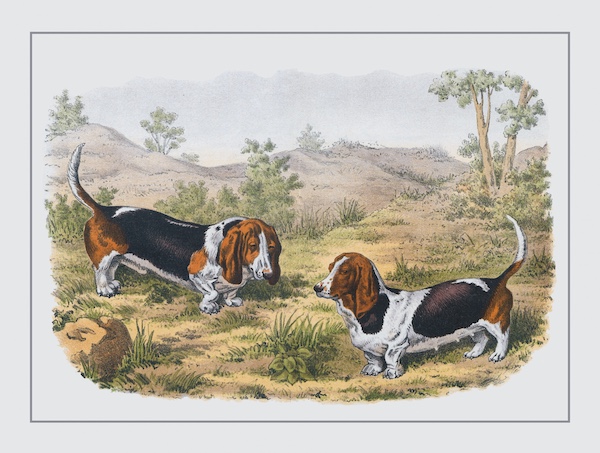
Image: Vintage painting of two Basset Hound dogs in nature is in the public domain.