The color “sedge” is famously associated with the Chesapeake Bay Retriever, but did you know that the color wasn’t added to the AKC breed standard until 1993?
That may come as a surprise, especially since sedge sounds as if it has always belonged to the Chesapeake. In truth, it probably did belong to the breed’s everyday vocabulary long before it appeared in the official standard. The word feels too perfectly suited to a dog developed to work among the reeds, tidewater, marsh grass, mud, and weathered vegetation of the Chesapeake Bay.
But if we have learned anything from looking into dog-breed terminology over the years, it is that familiar words can hide very particular meanings.
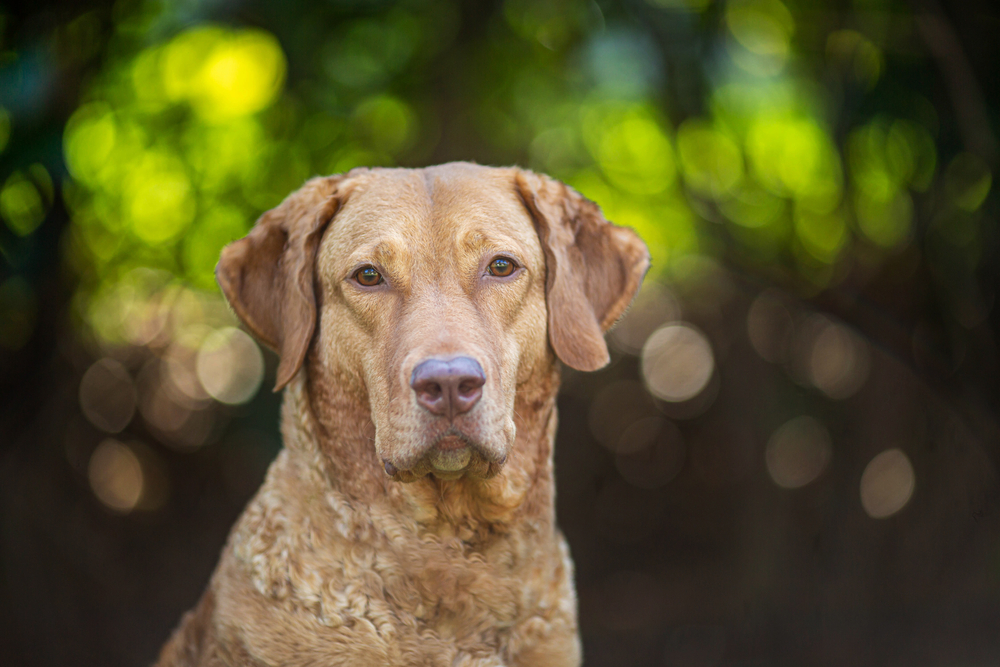
The American Chesapeake Club says that the breed comes in three basic color families: brown, sedge, and deadgrass. Brown includes everything from a light cocoa—sometimes described as silvered brown—to deep bittersweet chocolate. Deadgrass includes shades from faded tan to dull straw. Sedge is the color family with red in it, ranging from reddish yellow through bright red to chestnut.
That last detail is perhaps the easiest way to separate sedge from deadgrass: red matters. A pale Chesapeake is not automatically sedge. A dog may be light tan, straw colored, or even appear almost white in some lights and still be deadgrass if there is no significant red in the coat. Sedge, by contrast, carries that warmer cast of reddish yellow, red, chestnut, or mahogany.
And, as anyone who has ever tried to identify a dog’s color from a Facebook photograph knows, lighting lies.
A Chesapeake’s coat is famously dense, harsh, wavy, oily, and weather resistant. Add sunlight, shade, mud, water, a camera’s automatic color correction, and the coat’s own texture, and a brown dog can appear silvered, a deadgrass dog can seem gray or taupe, and a sedge dog can look anything from pale strawberry blonde to deep copper. The parent club specifically notes that coat and texture affect the perception of color.
The 1993 revision to the Chesapeake standard formally added the word “sedge” in the sentence now familiar to breeders and exhibitors: “Any color of brown, sedge or deadgrass is acceptable, selfcolored Chesapeakes being preferred. One color is not to be preferred over another.”
There is quite a bit packed into that one sentence.
First, brown is not preferred over sedge, nor is sedge preferred over deadgrass. The standard does not rank the three recognized color families. What it does prefer is selfcolor: one color all over, though lighter and darker shadings of that same color are allowed.
That does not mean a Chesapeake with some other marking pattern is automatically unworthy of consideration. The American Chesapeake Club notes that masking on the skull, light-and-dark striping, saddle markings, agouti coloring, and tan points may occur. Such patterns are not preferred, but color alone should not result in a disqualification.
That distinction is important in a dog whose coat, balance, angulation, head, size, and ability to function as an athletic working retriever matter so much more than a few extra color markings. Color accounts for only four points in the Chesapeake standard. A mediocre self colored dog should not automatically defeat a better specimen simply because the better dog has a minor variation in pattern.
Sedge, incidentally, was not invented in 1993. The word had already appeared in Chesapeake history. In the American Chesapeake Club’s “Historical Notes on the Chesapeake,” Alex Spear included an account of two dogs hunted on Maryland’s lower Patuxent River in 1862. One of them, Jeff, was described as “a reddish yellow or sedge color,” while the other, Lee, was described as gray or ash colored.
It is a marvelous quotation, but it needs to be used responsibly. The article was reproduced from an ACC Bulletin of the 1970s and does not identify who originally wrote the Jeff-and-Lee description, when it was written, or whether it represents the earliest use of sedge for a Chesapeake color. We can safely say that an American Chesapeake Club-preserved historical account used the word in describing a dog hunted in 1862. We cannot safely claim that it was the first time the word was ever used, or attribute that particular description to Jay Towner.
In the end, sedge is a reminder that the Chesapeake’s vocabulary is as practical as the breed itself. It is not a fashionable shade name dreamed up for a paint chart. It is a word rooted in a working dog’s landscape, later refined into a precise breed-standard term. And when you see that reddish glow in the coat of a Chessie standing against faded grass, muddy water, and autumn marsh, it is hard to imagine a better word for it.
Image: Portrait of a Sedge Chesapeake Bay Retriever by Kerrie T/Shutterstock