Conformation in a show ring is a judgment call, a subjective opinion put against a breed standard. This is even more true when the critique is based on photos.
With that in mind, nothing here is offered as a verdict — only as an honest attempt to look past a sweet face and read what the standard actually asks us to see.
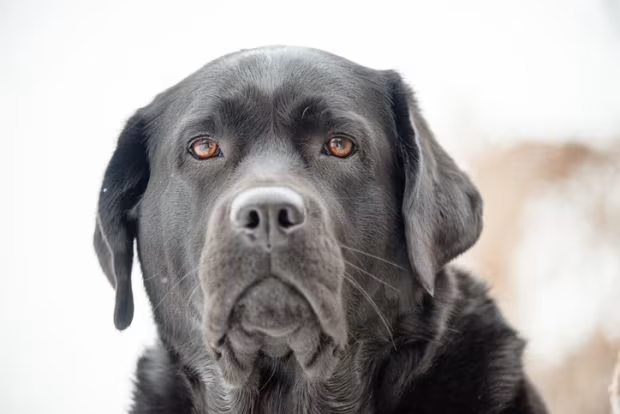
Somewhere between the loyalty in a Labrador Retriever’s eyes and the specifications on a printed page lies the argument for breed standards. This particular dog has exactly the kind of soulful, sweet face that makes newcomers to the breed insist he’s “just right.” Measured against the standard rather than against sentiment, his head tells us a different story — and a useful one for anyone learning to see a Labrador critically.
We start with the profile.
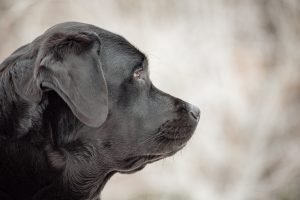
The official AKC standard calls for “a moderate stop—the brow slightly pronounced so that the skull is not absolutely in a straight line with the nose,” and identifies a wedge-shaped head as incorrect. In this photograph, the dog shows very little change of plane between the skull and muzzle. Although a slight depression is visible above the eye, the stop appears more defined than the standard describes, giving the head a long, somewhat wedge-like profile. The Labrador Retriever Club’s official Illustrated Standard specifically cautions against “wedge-shaped heads lacking stop.” A frontal or three-quarter view would be needed to determine whether the head is genuinely wedge-shaped, but in profile this dog appears to lack the moderate stop characteristic of correct Labrador head type.
Then there is his mouth. Both the top photo and the profile photo show lips hanging loose and pendulous well past the jawline, rather than the close, clean-cut mouth the breed calls for. The AKC standard is direct: lips “should not be squared off or pendulous, but fall away in a curve toward the throat” — language the Illustrated Standard echoes by naming “loose, sagging flews or lips” outright as a fault.
His eyes complete the picture. The standard asks for eyes that are “medium size, set well apart, and neither protruding nor deep set,” warning that “round prominent eyes are not typical of the breed.” His read rounder and more open than that — the same look the Illustrated Standard flags separately as “round or protruding eyes” among its faults to avoid — trading the kind, friendly expression the breed is known for, for something softer and, structurally, less correct.
None of this makes him a bad dog, or an unlovable one. It makes him, structurally, a lesson: proof that a head can be full of warmth and still fall outside the lines a judge is directed to look for, and a reminder that the standard exists to protect type, not to flatter our first impression of a friendly face.
Photos by Lesia Kapinosova/iStock
Okay. I train labs as service dogs so look at a lot of labs. I would need to see a specific comparison to understand why you are saying this dog does not have a ‘moderate stop’ or that its head is wedge shaped. I see lots of reasons this lab isn’t a good show specimen. You say ““a moderate stop—the brow slightly pronounced so that the skull is not absolutely in a straight line with the nose,” But from the picture I cannot see how that doesn’t fit. There is nothing in his head that looks wedge shaped to me without a comparison picture illustrating it. From the FRONT it looks more wedgy than the side. So I am just confused.