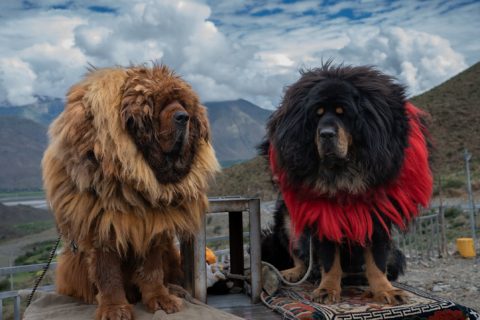
A Tibetan Mastiff hardly needs help looking impressive, but this photo prompted us to revisit the kekhor, which we last wrote about in 2018. Thousands of readers have joined us since then, and some may be asking, “What the heck is a kekhor?”
A kekhor (also written ske’kor) is the enormous, shaggy collar you see around the dogs’ necks in the photo. Its name is commonly explained as ske, meaning “neck,” and kor, meaning “circle.” A neck-circle: wonderfully plain language for something so spectacular. Traditionally made from yak hair, it is often dyed red, though yellow, black, and mixed-color examples have also been reported.
Why put one on a dog that already has a magnificent coat? A kekhor can help a herder recognize a dog at a distance, and its mass makes an imposing guardian look bigger still. When the long hair moves in the wind, one account likens the effect to a circle of flames around the dog’s head. Some owners also regard the thick collar as extra protection for the neck if a predator attacks. We admire tradition and can understand the thinking, but we wouldn’t bet the dog’s safety on yak hair stopping a wolf’s or snow leopard’s bite.
Trying to determine how long dogs have worn kekhors sent us down a rabbit hole. The Drokpa Tibetan Mastiff account of traditional dog collars, one of the most detailed English-language sources we found, says frescoes at Mongolia’s Erdene Zuu monastery show dogs wearing them. The monastery was founded in 1585, but we haven’t independently examined or dated the particular frescoes. It’s an intriguing clue, not a date we can confidently hang our editorial hat on. Drokpa also describes a photograph taken in Nepal and published in Emil Hauch’s 1965 Die Rassen des Hundes showing dogs wearing kekhors.
Not every colorful or protective collar on a dog in the region is a kekhor. Drokpa describes red fabric-triangle collars in Mongolia that appear to echo its look without offering the same substantial neck covering. The account also mentions collars for short-haired mastiffs and sha-khyi hunting dogs, and pointed metal collars used in parts of northern India—different answers to the problem of protecting a dog’s neck. And wearing a kekhor doesn’t prove that a dog is purebred, valuable, or dangerous.
Nor is there just one way to make or fit a kekhor. Accounts describe collars that sit higher or lower on the neck, with longer or shorter hair and more or less bulk, depending on local practice and taste. Some older types reportedly incorporate bones from a yak’s tail to give the collar structure. Some have bells, though we couldn’t find a reliable source assigning those bells a meaning specific to kekhors. They may simply make a dog easier to hear. And while red is the color most people associate with the collar, we haven’t found a dependable source explaining what yellow, black, or mixed-color kekhors might mean, if anything.
We have more questions. Who makes kekhors—women or men? How old is a dog when it first wears one? Do young dogs try to chew them off? We looked, but couldn’t find dependable, kekhor-specific answers.
We can at least address a question prospective buyers might have: do they smell? Owners have reported that a new yak-hair collar can arrive with a distinctly barnyard aroma. A thick collar may also take time to dry if it gets wet, and damp animal fiber can smell stronger. Your particular kekhor may vary, but we would ask its maker about cleaning and drying it before giving it a bath.
If you’re thinking of buying one, ask a few more questions first. What is the collar’s inner circumference? What holds the yak hair in place? Are there loose fibers, bells, or other parts a dog could pull or chew off? And how should you care for it? Introduce any elaborate collar while you can watch the dog, and check that it doesn’t rub or catch on anything.
We found kekhors offered by Gandhanra-ART, which lists red yak-hair collars in different layered styles, and by individual Etsy sellers. Check current measurements, materials, construction, shipping, and return terms before ordering. A seller’s story about ancient warriors or sacred powers may be appealing, but we’d raise an eyebrow and treat it as a colorful sales pitch unless it comes with a source.
The kekhor is striking enough to stop us in our tracks. What kept us looking was the realization that, beneath all that yak hair, there are still things we don’t know. If you’ve made one, fitted one, or lived alongside dogs that wear them, we’d welcome your firsthand knowledge.