
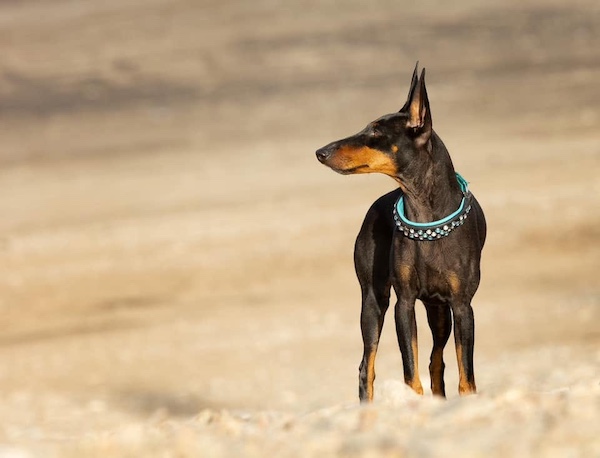
When one small black-and-tan dog carries the vocabulary of flowers, fingerprints, drawing and clothing, you are probably talking about a Manchester Terrier. Where it gets really interesting to us is that we can compare four official standards of the same breed and find that breed language can change across countries even when the physical markings being described are substantially the same.
Let us begin with the flowers.
The AKC Manchester Terrier standard calls the small tan spots on each side of the chest above the front legs “rosettes,” adding that they are more pronounced in puppies than in adults. The United Kennel Club standard uses the same name and makes the same observation.
Cross the Atlantic, however, and the flowers disappear—or at least the word does. Both the Royal Kennel Club standard and the FCI standard simply call for “a slight tan mark on each side of the chest.” Same general location, considerably less horticulture.
Next come the fingerprints. The AKC calls for a black “thumb mark” on the front of each foreleg at the pastern, surrounded by tan. The British and FCI standards compress this to thumb mark, while the UKC also uses “thumb mark.” No actual Sherlock Holmes paw-printing is involved; the term describes a distinct black patch in a prescribed place.
Then there is the life drawing lesson. All four standards call for black pencilling on the toes, although their descriptions differ in detail. “Pencilled toes” does not mean feet broadly covered in black. It means narrow, clearly delineated black lines—the visual equivalent of someone having taken a very fine pencil to each toe.
Finally, there is breeching, and this is where the same ‘dog-world word’ can lead an uninformed reader badly astray.
The AKC’s general glossary of canine terms defines breeching as the fringing of longer hair along the back borders of the thighs. In the UKC’s Australian Cattle Dog standard, for example, the coat under the body becomes longer and forms “slight breeching” on the backs of the thighs. There, breeching is perfectly proper: it is coat furnishing.
It is not perfectly proper on a Manchester Terrier.
The Royal Kennel Club and FCI Manchester standards use breeching for tan coloring on the outside of the hind legs—and specifically call it undesirable. Why? Because the prescribed Manchester pattern places tan on the inside of the hind legs while leaving the outside black. In this breed and this sentence, breeching is not an admired fall of longer thigh hair; it is tan appearing where black should be.
The AKC and UKC Manchester standards reach essentially the same visual destination without using the word: both state that the outside of the hind legs is black.
This is exactly why breed terminology must be read in context, and why one should read one’s breed standard. Breeching may describe an acceptable—and even expected—coat furnishing in one breed while identifying an undesirable color marking in another. The word has not changed clothes; the breed has changed its meaning.
We have a timely reason to revisit this vocabulary. The FCI’s breed listing gives September 8, 2026, as the publication date of the official valid standard and October 6, 2026, as the publication date of the English-language standard. The English-language PDF retrieved through its standard link, however, still bears a 2011 date. That older document uses pencilled, thumb mark and the undesirable Manchester form of breeching, but the listing alone doesn’t establish whether the newly published version keeps that wording.
And that, gentle readers, is how one sleek little terrier manages to wear rosettes, carry thumb marks, sport pencilled toes and warn us about the wrong sort of breeches—all without adding a single accessory.